Monday, 4 January 2016

The Bookshelf Survery

Getting back into the swing of things after Christmas seemed the perfect time for a bit of fun. Book-related fun is all the better, so a big thank you to the lovely Dee Dee Chainey for tagging me in the Bookshelf Survey. (Though let's face it, we hardly need an excuse to talk about books!) 


Find a book on your shelves for each of your initials.

(I have a confession to make on this one. My first response was “Oh dear, I'm not sure I'll have any that start with W....” Then I looked. Yeah. I read and write mostly about witches. Enough said....!)

It was very hard to pick two, but I finally decided on:


Witchcraft, Magic and Culture, 1736-1951 by Owen Davies.
This fantastic book was actually one of the first I read on witchcraft history. Covering a period often neglected in witchcraft studies it looks at beliefs and practices relating to witchcraft across all sections of society in the decades after the passing of the 1736 witchcraft act. I love Owen Davies' style and anything by him promises to be a good read, but this is my favourite and sparked my own interest in 19th century witchcraft cases.


Witches and Wicked Bodies by Deanna Petherbridge. 
This was the exhibition guide to the Witches and Wicked Bodies exhibition at the British Museum last year. The guide "provides an innovative, rich survey of images of European witchcraft covering from the sixteenth century to the present day. It focuses on the representation of female witches and the enduring stereotypes they embody, ranging from hideous old crones to beautiful young seductresses." It's still available to buy on Amazon and would highly recommend it especially if you didn't get to see the exhibition in person.

Count your age along your bookshelf. What book did you land on?


 Folklore Myths and Legends of Great Britain by Reader's Digest.
It seems I had a deprived childhood without knowing it, as everyone else I know seems to have had this book in their lives a long time before I even knew it existed. My fellow #FolkloreThursday hosts soon rectified the situation however, and now I can read about everything from giants to haunted stately homes to mermaids and everything else in between to my heart's content. It truly is a most fabulous book and there was only a limited print run, so snap up a copy (or snag your dad's!) before they all go. My only trouble now is that my 7 year old wants to have mine on permanent loan!

Find a book that takes place in your city or state.


Derbyshire Ghost Stories by Jill Armitage. 
A lovely little book filled with local ghostly tales, this book is great for flicking through for inspiration or if you just fancy dipping in for a story or two. There's the added bonus that there aren't a lot of historical sources mentioned, which gives plenty of scope for going off and getting happily lost in research. 

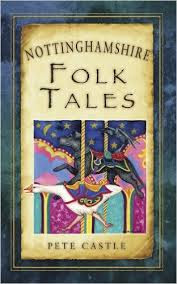
And because we're so close to the boundary of Nottinghamshire, Nottinghamshire Folktales by Pete Castle also needs a mention, not least because of the gorgeous artwork by Karen Soutar on the cover. 


Find a book cover in your favourite colour. 


 I don't seem to have any purple covered books! So instead I will cheat and share my favourite book cover of all time – that of Lloyd Shepherd's Savage Magic. I fell in love with the cover the first time I saw it, and the book itself more than lives up to it. If you like well-told historical fiction with a hefty dose of madness, magic and maleficium this is definitely worth a read!

Which book do you have the fondest memories of?


Little Women by Louisa May Alcott. 
I've lost count of how many times I've read this one, and it's certainly not one I've left behind with childhood. I regularly re-read the whole series that charts the story of the March family, but the first one is always going to be my favourite. I'm not ashamed to add that it makes me cry!


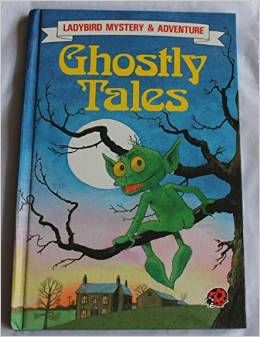
Ghostly Tales by Ladybird.
This also has to be mentioned here because it is the book that has scared me the most ever. I begged my mum to buy it for me from Woolworths when I was about seven and freaked myself out good and proper by reading it over and over. (Didn't help that we lived in the house below at the time - perfect spooky setting!) Does anyone else remember the book? I have my old copy here but can't bring myself to open it again....!


Which book did you have the most difficulty reading?


The Lord of the Rings by J R R Tolkien. 
I've started it four times now and haven't managed to get further than about 300 pages in. Think I've been beaten by this one!

Do you have a special place at home for reading?
I do a lot of reading in the bath! I think that's partly because it's one of the few times during the day when I can justify it (or at least when it isn't work related.) I also read a lot at my desk when I'm doing research etc. 

Can you read while listening to music/ watching TV?
Nope! I find it really hard to focus on reading if there is any background noise, which can sometimes be rather a challenge!

What do you use for bookmarks?
Had to laugh at Dee's answer to this, as I am also guilty of using random bits of tissue that happen to be at hand! I also use bits of paper and sometimes, rarely, actual proper bookmarks.

Are your book spines creased or unbroken?
Crease and proud of it!

What is the last book you bought?


The Faerie Thorn by Jane Talbot.
I've not read it yet as it was a Christmas present but very much looking forward to this one! 


Hope everyone had a wonderful Christmas - Wishing you all a Happy New Year, and there'll be more from The Witch, The Weird, and The Wonderful soon!


Wednesday, 16 December 2015

Wednesday Weirdness: Foiling the Surgeons

With the festive season truly upon us, this week brings with it the last Wednesday Weirdness slot of 2015. It is with great pleasure that I welcome Suzie Lennox to The Witch, The Weird, and The Wonderful to share her knowledge on the fascination and often gruesome topic of bodysnatching. 

*********

The fear of dissection laid heavy upon many a parishioners heart. Likewise, if you were condemned to death and dissection was part of your final sentence, then no doubt your palms would begin to sweat some more. If your final resting place was the local churchyard, a niggling doubt might mean your thoughts turned to the resurrection men, and the crumpled sack that might be lying next to your grave waiting to take your dead body to the surgeons. Sometimes, if you were lucky enough, your friends would rescue you from the fate of the surgeon’s knife; bundling you into the back of their cart and whisking you away from the gallows for a decent burial, but not before struggling with your body, pulling it back and forth with some more than determined surgeons on the other end. 

On occasion, no amount of tugging and pulling could wrench your body from a determined surgeon, but sometimes, your friends might win out. Who knows, even the bodysnatching preventions that you have ensured will be placed on top of your grave might actually work and the resurrection men will target some other poor soul in the churchyard. 

Dissection was invasive; skin stripped from your body, veins and arteries pumped full of coloured wax and then the unknown fate of your skeleton after the fat and sinew were boiled from it was not worth thinking about. It was to be hoped a rescue could be made somehow.

Only a true friend would go to extreme lengths to ensure your body was unsuitable for the surgeons. In February 1815 friends of John Worthington showed just how much he had meant to them when they tried to save his body from the surgeon’s knife. After John had been hanging for an hour, his friends rescued him from the gallows and poured vitriol and quicklime into his coffin which 'caused a fume to rise in volumes from the grave’. They then sealed the lid and buried him in a freshly dug grave in Low Churchyard, Kilmarnock, knowing that the surgeons would leave this particular cadaver alone.


Depending upon which way you look at things, the friends of the recently executed Mr Robinson went to more extreme measures to ensure their friend’s corpse was kept from the hands of the surgeons. In the summer of 1753, the Derby Mercury printed a short article detailing the death and burial of Mr Robinson:


Rest assured that both cadavers would have been rendered completely useless for the surgeons, and it is to be hope that the resurrection men knew about the quick lime and vitriol before trying to exhume the bodies!

You could of course just be plain unlucky. If alternative arrangements for your burial had been made and subsequently a body presented itself for dissection, the needy surgeons were not going to turn it away.  In November 1818, after struggling on the end of a rope and hanging for ‘the usual length of time’, John Barnet expired after being found guilty of breaking into a house in Aberdeen. His body was taken away and conveyed to a waiting boat to be buried at sea. But, rumour has it that the November tide washed poor John Barnet ashore only a few days later and his body was conveyed to the surgeons table to be dissected at leisure.

If local parishioners heard of a snatching or smelled something suspicious then hopefully they could react in time to prevent your body being whisked away for the surgeons. The story of ‘Dandy Jim’  has no doubt been reworded and retold in many a parish across the land, as have stories of bodies being discovered in the back of carts whilst the bodysnatchers in question nipped into a nearby inn for a refreshing dram. Some corpses were never to be seen again, but some were lucky and re-interred, often in the churchyard where the discovery was made.  Due to its location, Newcastle became a ‘hotspot’ for the discovery of bodies squashed into hampers or boxes, often loaded onto coaches bound for Edinburgh or London. Little 7 yr old Elizabeth Mills was found stuffed in a trunk at the Queen’s Head Hotel, Newcastle where she was ‘en-route’ to Edinburgh and one year earlier in 1828, Mary Jewitt was found at the Turf Hotel after being put on a coach in York. Rebecca Shearman was discovered in the wagon office of Messrs. Marsh & Swann in Cambridge in December 1830 after she was stolen from St Mary’s church, Ely and it is to be hoped that a mix up in packages at one Edinburgh coach office in 1829 between a cadaver and box containing ham, cheese and eggs resulted in the unfortunate recipients altering the authorities so that the cadaver could be reburied and left in peace!

But it is perhaps a father’s love for his child that ensures the surgeons didn’t get their hands on those children who had passed before their time, as the case reported in the Carlisle Patriot  in 1842 shows.  As guard of the Express coach which travelled between Hull and London, Mr Cuckson had no doubt witnessed his fair share of bodies being discovered in hampers, the smell of which would have been enough to cause any father to ponder ways of ensuring his loved ones would be safe in their graves.  When Mr Cuckson’s daughter died in 1832 he was determined that no surgeon would have the body of his daughter so he organised a mock funeral, instead burying her body in his back garden.  Sure enough, not long after the burial it was discovered that the grave had been disturbed by bodysnatchers.  Happening upon an empty coffin would have given the bodysnatchers an unexpected surprise and perhaps Mr Cuckson the satisfaction of knowing that not only had he foiled the bodysnatchers and the surgeons, but also that his daughter was buried in the back of his garden, secure in a coffin made out of window shutters.


Suzie has now been researching the dark tales of Britain’s resurrection men for over ten years, after becoming interested in bodysnatching whilst studying History at University. Newspaper clippings and archival evidence continually adds to a growing database which currently lists over two hundred individual resurrection men – please feel free to contact her if you find any during your research. For those interest in the darker side of history you can follow Suzie’s twitter account @diggingup1800 or read her blog Britain’s Forgotten Bodysnatchers.


Wednesday, 2 December 2015

Irish Fairies and Irish Food: The Mary Doheny Trial

As Wednesday Weirdness rolls round again, I am very pleased to welcome Dr. Simon Young to The Witch, The Weird, and The Wonderful with Irish fairies, food, and the sensational trial of Mary Doheny.

*********


In 1864 one Mary Doheny – ‘the wife of a blind man… with a reputation for preternatural powers’ (Anon 1067) – was brought to trial at Carrick-on-Suir, Tipperary, Ireland on a charge of swindling. The Crown alleged that, over the course of four months, Doheny had taken food from several townspeople on false pretences. This may at first seem a sordid and unremarkable episode; and so, indeed, in some senses it was. But this forgotten case – it has been completely overlooked by scholars – reveals some unusual Irish beliefs concerning food and fairies. Many studies in the last generation have looked at the folklore of food (see for overview Camp): this nineteenth-century Irish trial allows us to delve into food in folklore, a rather different but no less interesting and instructive proposition.


There are many hundreds of words given over to the Doheny trial in the Irish, and to a lesser extent, the British press of the day. However, for present purposes an account of the Doheny trial in the British periodical The Spectator will serve our needs, as it condenses without simplifying. The reader should be warned, some of these details are surprising, a consequence of the British legal system and Irish folk convictions colliding (Hickey 106-130). 

The charge against [Mary Doheny] was of cheating certain persons… out of subsidies not in money but in food, on the false pretence that they were for the support of deceased relatives of the contributors recently restored to life – or sufficiently so to need food. The scene in the Court-house of Carrick-on-Suir was a very curious one. People of all ranks thronged from all sides to hear the examination, and even the most educated persons present were, it is said, in parts of the evidence visibly awestruck and confounded by the simple faith and earnest testimony of more than one witness… (Anon 1067). 


The anonymous Spectator writer explains how it was believed that several ‘dead’ family members were coming back to life. By bringing food to the dead Mary Doheny claimed she could sustain these individuals and then return them to the world of the living. This was made all the more remarkable by the fact that a number of witnesses claimed to have seen their dead relatives while in Mrs Doheny’s presence! For example, Doheny showed Joseph Reeves, his dead father-in-law, William Mullins: a fact that, notwithstanding ridicule and laughter, Reeves – a policeman – swore to in court. 

We remained looking at [my dead father-in-law, William Mullins] for a time; he was standing in the field with a stick in his hand; his side-face was turned toward me… I don’t think that William Mullins is dead now; but he was dead. I have been sending him food for the last four months since he came to life. I sent bread, butter, and tea once in each of the twenty-four hours, sometimes by the defendant and sometimes by my wife’s niece. Defendant, asked in my presence for the food, and as it was after I had seen William Mullins alive, I consented (Anon 1067).


Reeves sent bread, butter and tea. Another witness brought tea, milk, butter, and bread to her dead uncle, Tom Sheehan. However, the diet of the dead or semi-dead was not always the same. The departed Father Mullins ‘smokes, and can manage new potatoes and eggs’. A dead child, on the other hand, was not strong enough for ‘potatoes and eggs’ and after an abortive attempt to send this kind of food ‘[the mother] changed the diet the next night’. Then the dead also proved choosy. ‘Some tea was sent back as not good enough… two months ago, and fresh tea of a better quality was substituted’ (Anon 1068). The food here amounts to a fair list of nineteenth-century Irish staples: available to, depending on the date, the rural poor and the lower middle classes (Diner 84-112). 

Now what, on earth, is going on in this account? The newspapers that wrote about Doheny described her as a ‘witch’, but it would be closer to the truth to call her a ‘fairy woman’ or a ‘fairy doctor’: the nineteenth-century media, particularly in Britain, constantly misunderstood Irish fairy superstitions, confusing the same with witchcraft (Bourke 128-129). And it is important, for present purposes, to note that, in nineteenth-century Ireland, certain men and women lay claim to being the intimates of the fairies, deriving their power from close relations with the world of fairy (Bourke, 24-38); some even claimed to be fairies come to live among humanity (Young). Fairy doctors, of whom the most famous was Biddy Early (Lenihan), worked cures, intervened to solicit protection from fairies and, as here, communicated with the dead. 


This ability to communicate with the dead was not as alien to the fairy faith as one might at first think. There was still, in nineteenth-century Ireland, a belief that the dead (or at least some of the dead) were ‘taken’ by the fairies and that they went to dwell in the happy fairy realms under fairy raths or forts. So powerful was this belief that certain scholars have even used it as proof that the fairies were originally themselves the spirits of the dead (Spence). This is questionable and need, in any case, not detain us here. But it is important to understand that Doheny’s authority was based on her ability to reach these dead relatives trapped among ‘the good folk’ and to return them to life.

But why food? Here we must deal with this question at the vulgar level of practicalities and at the more elevated level of folklore. First, the practicalities. Fairy men and women may or may not have had ‘powers’. Bt they had a well-deserved reputation for charlatanism. I have documented many cases of this kind of dishonesty in nineteenth-century Ireland; and there are even three dramatic cases – one of which ended in court – where individuals arrived at Irish homes claiming to be recently dead family members, returned from among the fairies (Young 2012). These fairy swindlers depended on sleight of hand, ham-acting and pyrotechnics and they were quite able to have someone stand in for a dead relative to convince a grieving family of their authority. Consider this account from the writings of Lady Wilde (Oscar Wilde’s mother). 

A young man died suddenly on May Eve [a fairy feast] while he was lying asleep under a hay-rick, and the parents and friends knew immediately that he had been carried off to the fairy palace in the great moat of Granard. So a renowned fairy man was sent for, who promised to have him back in nine days. Meanwhile [the fairy man] desired that food and drink of the best should be left daily for the young man at a certain place on the moat. This was done, and the food always disappeared, by which they knew the young man was living, and came out of the moat nightly for the provisions left for him by his people. Now on the ninth day a great crowd assembled to see the young man brought back from Fairyland. And in time stood the fairy doctor performing his incantations by means of fire and a powder which he threw into the flames that caused a dense grey smoke to arise. Then, taking off his hat, and holding a key in his hand, he called out three times in a loud voice, ‘Come forth, come forth, come forth!’ On which a shrouded figure slowly rose up in the midst of the smoke, and a voice was heard answering, ‘Leave me in peace; I am happy with my fairy bride, and my parents need not weep for me, for I shall bring them good luck, and guard them from evil evermore.’ Then the figure vanished and the smoke cleared, and the parents were content, for they believed the vision, and having loaded the fairy-man with presents, they sent him away home (Wilde 200 and, for comments, Briggs 150-151).

The reader will notice the repetition of food here. In instances like this and the Doheny case food was presumably a necessity for the swindlers – who had to eat – and so food proved convenient. It did not arouse the suspicion of relatives and community in the way that requests for money might have; though money was also frequently demanded. And there was the hope that at the end, as here, the fairy doctor would be rewarded.


However, there are also folklore reasons for asking for food. In myths from around the world, there is the idea, familiar to most of us in the tale of Persephone, that visitors to the underworld should not consume the food of the ‘spirits’ (to be as generic as possible). In 1891, in one of the pioneer works on British folklore, Hartland tied this belief, in a short and still important chapter, to fairy belief and the legend of the fairy midwife (37-58). Those, he argued, who go to the fairy world risk being eternally trapped there should they be so foolish as to eat the fairies’ food. And even a glancing familiarity with British or Irish or for that matter German or Mediterranean fairy lore confirms his thesis (Silver 1999, 171 and Silver 2005, 105). Jeremy Harte, indeed, sums it up in his wonderful survey of the fairy world writing: ‘[t]he simplest rule, and the one which appears in almost all narratives of a journey to the Otherworld, is easily remembered, don’t eat’ (Harte 81).

Take this episode from one of the most famous English fairy stories, written down some ten years after the Doheny trial. Mr Noy has stumbled, quite unwittingly, into Fairyland and is observing an extraordinary fairy revel.

[Mr Noy] noticed that the damsel [among the fairies] who played the music was more like ordinary folks for stature, and he took her to be the master’s daughter, as, when one dance was ended, she gave the crowd to a little old fellow that stood near her, entered the house, fetched there from a black-jack, went round the tables and filled the cups and tankards that those seated, and others, handed to be replenished… [Then she] went towards the orchard signaling to Mr. Noy to follow her, which he did. When out of the candle-glare and in a clear spot where moonlight shone, she waited for him. He approached and was surprised to see that the damsel was no other than a farmer’s daughter of Selena [the local village], one Grace Hutchens, who had been his sweetheart for a long while, until she died, three or four years agone; at least he had mourned her as dead, and she had been buried in Buryan Churchyard as such. When Mr. Noy came within a yard or so, turning towards him, she said, ‘thank the stars, my dear William, that I was on the look-out to stop ye, or you would this minute be changed into the small people’s state like I am, woe is me.’ He was about to kiss her, ‘Oh, beware!’ she exclaimed, ‘embrace me not, nor touch flower nor fruit; for eating a tempting plum in this enchanted orchard was my undoing’ (Bottrell II, 94-102 at 97-98 )

Doheny and the nameless fairy doctor in Wilde’s account are acting not just according to their own interests, but according to the demands of folklore. By giving staples to the prisoners of the fairies, they are preventing them from ingesting fairy food, food that would trap them in the fairy world for ever. The Spectator describes Doheny’s logic in the following terms.

The witnesses called against Mrs Doheny certainly testified to the continuous stream of subsidies with which they had supplied her for their rather uncomfortably situated relatives, who appear to have half got back from the grave, but still to be, if we may so term it, spiritual invalids living on earth, but in mysterious seclusion amongst ‘the good people’, and preparing on a mild diet of tea and other food generally known to the medical profession as ‘slops’ for their more active return to life; but while they gave this evidence, they not only imputed no falsehood to Mrs Doheny, but were even eager in their simple faith that the subsidies had actually been needed and consumed by their half-reanimated kinsmen, whom they had, they said, seen with their own eyes (Anon 1067).

There are cases from elsewhere in Europe where, in folklore, the dead avoid eating fairy food and depend on rations from outside. But the only examples I have found from the nineteenth century where individuals actually act on these beliefs are from Ireland. How can we explain this fact? Is it just the perseverance of pre-Christian or, better, non-Christian beliefs or are we dealing with something more? Perhaps the answer lies in that grievous nineteenth-century Irish experience: starvation. The potato famines, which blighted the Irish nineteenth century, causing hundreds of thousands of deaths and leading hundreds of thousands to emigrate, mattered in another way (Diner 113-116). They created – as in other periods of famine (Pleij, 100-117; Dickie 100-117) – a strong sense of solidarity between the starving or semi-starved, where food and access to food were mythologised. It was the recent memory of hunger, as much as traditional belief, that, we suspect, made relatives, a decade or so after an Gorta Mór, so attentive to the needs of their famished dead.

*********
Dr Simon Young is a history lecturer at the International Studies Institute in Florence. He has written, in the last years, on witch and fairy belief in eighteenth- and nineteenth-century Britain and Ireland in several reviews including Folklore, Studia Hibernica and Nomina. To read more, visit https://umbra.academia.edu/simonyoung


Bibliography

Anon, ‘The Tipperary Witch’ The Spectator (1864), 1067-1068
Bottrell, William Traditions and Hearthside Stories of West Cornwall (Penzance, Beare and Son, 1870-1880), 3 vols.
Bourke, Angela The Burning of Bridget Cleary: A True Story (London, Pimlico 2006)
Briggs, Katharine The Fairies in Tradition and Literature (Routledge, London 2011)
Camp, Charles ‘Foodways’ Folklore: An Encyclopedia of Beliefs, Customs, Tales, Music and Art 2 vol (ed) Thomas Green (Santa Barbara, Bio-Clio 1997) II 366-371
Dicke, John Delizia: The epic history of Italians and their food (London, Sceptre 2007)
Diner, Hasia Hungering for America: Italian, Irish and Jewish Foodways in the Age of Migration (Cambridge Mass., Harvard University Press, 2002)
Harte, Jeremy Explore Fairy Traditions (Loughborough, Heart of Albion Press 2004)
Hartland, Edwin Sydney The Science of Fairy Tales: An Inquiry into Fairy Mythology (London, Walter Scott Publishing 1891)
Hickey, Éanna Irish Law and Lawyers in Modern Folk Tradition (Dublin, Four Courts Press 1999)
Lenihan, Edmund In Search of Biddy Early (Cork, Mercier Press 1987)
Pleij, Herman Dreaming of Cockaigne: Medieval Fantasies of the Perfect Life (New York, Columbia University Press 2001)
Silver, Carole G. ‘Tabu: Eating and Drinking, Motifs C200-C299’, Archetypes and Motifs in Folklore and Literature: A Handbook (ed) Jane Garry and Hasan El Shamy (New York, M.E. Sharpe 2005), 103-107.
Silver, Carole G. Strange and Secret Peoples: Fairies and Victorian Consciousness (Oxford, OUP 1999)
Spence, Lewis British Fairy Origins (Wellinborough, The Aquarian Press, 1981)
Wilde, Lady Ancient legends, mystic charms, and superstitions of Ireland (Boston, Ticknor and Co 1887)
Young, Simon ‘Fairy Imposters in Longford during the Great Famine’ Studia Hibernica 38, 181-198


Monday, 30 November 2015

All That Glitters: James Price and the Death of Alchemy.

It's never easy to admit when you're in the wrong. You might at first try to avoid the issue, then perhaps tell a small untruth in the hope to avoid detection. Then as time goes on and you continue the charade it's harder and harder to come clean, and before you know it you've backed yourself into a corner and admitting the truth is nigh on impossible. It's a situation many will be familiar with, but in 1783 James Price, chemist and alchemist, took matters to tragic extremes.

Price, born as James Higginbotham in 1752, was a remarkable individual. Attending Oxford he obtained a Master of Arts at the age of twenty-five, became a Doctor of Medicine a year later, and in 1781, at the age of twenty-nine, became a member of the Royal Society. 


© National Portrait Gallery, London


It is unclear just when Price's interest in alchemy began, (the somewhat fantastical story that he inherited his fascination and equipment from a mythical Doctor Irish cannot be substantiated) but in 1782 he began work on the project that was to ultimately ruin both his career and his life. 

Working in his laboratory at his home in Stoke, near Guildford, Price's aim was soon clear - the changing of  base metals into precious ones, most of all, the changing of substances into gold and silver. It was a goal shared by many, but unlike his predecessors, Price appeared to have been successful.

On 6th May 1782 Price demonstrated his results to an assembled group of friends. They were hugely impressed, and, buoyed by this success he embarked upon a set of public experiments to further display his findings. 

There were seven demonstrations in total, attended by some of the greatest in the country. During the process a “flux composed of Borax”, a small piece of charcoal and a small piece of nitre were pounded together before with a pestle in full view of those watching, the ingredients also having been examined carefully by the same. This was pressed into a small hessian crucible onto which half an ounce of Mercury was carefully added. It was then that half a grain of “a certain powder, of a deep red colour” was added; indeed it was these very powders that Price claimed were the key to his success. The crucible was placed in the fire of a “moderate red heat”, with “Dr P” keeping a close eye on developments and urging others too to watch every stage of the process. Then:

“In about a quarter of an hour, from the projection of the powder, and the placing of the crucible in the fire, he observed to the company, who on inspection found his observation true, that the mercury though in a red hot crucible, shewed no signs of evaporation, or even of boiling.”

The heat was gradually increased before an iron rod was dipped in – to the astonishment of those watching there were small “globules of a whitish coloured metal.” The best was yet to come however; once the fire was raised further and borax added, the crucible was finally removed and broken open whereupon:

“A globule of yellow metal was found at bottom, and in the scoriae smaller ones, which collected and placed in an accurate balance by Mr Russell, were found to weigh fully ten grains.”

The sample was sealed up with due ceremony to be sent away for testing, but it was clear to all those who had witnessed the experiment that the substance was genuine. Sure enough, the following day Price's assertions were confirmed: he had produced gold. 


The rest of the series of experiments produced similar encouraging results. The final experiment took place on Saturday 25th May, 1782 before an assortment of prestigious personages, including Lords Onslow, King and Palmerstone. This was no less successful than the previous experiments, with both gold and silver produced to the astonishment and excitement of those watching.  

“These last portions of Gold and Silver, as well as a part of the produce of the former experiment have had the honour of being submitted to the inspection of His Majesty, who was pleased to express his royal approbation.”

Price published his findings in “An Account of some Experiments on Mercury, Silver and God, made at Guildford in May 1782 in the laboratory of J. Price.” which became a bestseller.  Aware that people hearing of his work might be duly sceptical, Price added the assurance that:

“One or more of the Company, particularly the Lords King and Palmerstone, were during the whole time of the Experiment close to the furnace and operator; and as requested by him gave the closest attention to every part of the process.”  

There were those amongst his colleagues of the Royal Society however who were not quite so convinced. Among those who were particularly sceptical were Joseph Banks, the president of the Society, and the chemist Joseph Black.Price was asked to do further experiments, this time in their presence and under controlled conditions. Despite his previous success, Price made many excuses, ranging from the fact that his powder had run out, to the fact that producing more would not be economically unsound but also pose a serious threat to his health. 

After much arguing back and forth however, Price had no choice but to submit to the insistence of the Society. He duly retired to Stoke in the January of 1783, where he intimated that he was preparing the powder required for the experiments. 

Finally a date was set for Price's demonstration, and on 3rd August those members of the Society due to observe arrived in Stoke. Some tellings of the story imply that Price had a large audience, but in truth only three arrived to witness the experiment. Price met the men and greeted them cordially, betraying no hint of what was to come. Suddenly he stepped aside, drinking from a flask or glass he had concealed. It was moments later that the men realised something was terribly wrong, but it was too late – beyond helping, Price died before them, choosing death over the shame of admitting that he would not be able to prove his claims. He was thirty-one years old.  

James Price was buried at St John The Evangelist, Stoke, Surrey.


No one knows for certain what led Price to his terrible end. Had it been a hoax from the start that ultimately went too far? Or had Price believed his own claims, only to realise with horror that he had been wrong? There have been claims of mental instability made against Price, although these of course cannot be substantiated. One of the most intriguing explanations rests on the fact that only three men turned up to see Price for that final, fateful experiment. It has been suggested that these men were actually working with Price - either helping him to fake his own death, or, with a decidedly more sinister twist, that they were there with the purpose of convincing him to commit suicide.

Whatever the course of events, it is generally believed that Price's death brought with it the end of alchemy in England. After his suicide, the Royal Society refused to carry out any further investigations into alchemical claims.


Monday, 16 November 2015

Highway Robbery: The Curse of Tupton Hall

Over the summer I bought a small book of Derbyshire ghost stories. Whilst flicking through I came across a tale that caught my attention relating to Tupton Hall near Chesterfield. Today there is a school on the site where the old hall used to stand, but it was once an opulent country estate in the possession of the prosperous Lord family. According to the legend, Mr Lord, a wealthy Chesterfield miller:

“Was returning home one evening when he was waylaid and robbed by a masked highwayman. He was convinced that it was the family coachman, and, although the poor man swore his innocence, Mr Lord had him tried, convicted and hanged.”

The kick to the story comes in the ending, as we are told ominously:

“Just before his execution, the man swore a curse on the family and predicted that disaster after disaster would follow.”


A fascinating albeit rather standard ghost story to be sure, and I experienced the shiver that the writer intended. As with so many stories however I was left with the desire to know what, if any, truth lay behind it. After some digging and exchange of emails with a very helpful gentleman from the Tupton Local History Society, the following came to light, through a piece in the Derby Mercury, dated Thursday, 27th December, 1739.


We hear from Chesterfield, that on Saturday night last, Mr Lord of Temple Normanton, near the said Town, going from Chesterfield Market, was attack'd by a single Highwayman on his Return Home, who robb'd him of 10l and two Gold Rings; and that about a Quarter of an hour after Mr Tag of the same Place, with his Wife behind him, returning from the said Market, was also robb'd by the same Highwayman; and that a grey mare belonging to -- Pyot Esq; of Highfield near Chesterfield, was taken out of a Stable at the Angel Inn there, the same Night, which was thought (by the Description given) to be the same the highwayman was mounted on; Mr Pyot, upon sending his Servants out to search for her, found her turn'd up, and in the Road Home with Bridle and Saddle on.”


It would seem that this was indeed the Mr Lord mentioned in the tale of the Tupton Curse; Temple Normanton was only about a mile from Tupton, and it is likely that Mr Lord was returning from Chesterfield to Tupton Hall when the attack occurred. The report ends with the information that a man named Dolphin had been taken in under suspicion of being involved in the crime, having been tried at the last Lent Assizes for “stealing one Moydore and 3l. 1s. from Mr Inman of Chesterfield.” Although he was acquitted of the previous crime, the man had now been committed to the Chesterfield House of Correction for questioning over the theft from Mr Lord.

Tupton Hall, c.1800

A series of relations in the Derby Mercury for 1740 adds further details. On 27th March it is related that at the Assizes that lasted the previous Friday, three people were sentenced to death; Samuel Gilbert, for the crime of stealing a black mare, and:

“William Dolphin and James Hill for Robbing Mr Lord near Chesterfield on the Highway, of a considerable Sum of Money.”


Richard Thompson and Joseph Baron were also suspected of being involved with the robbery, but were acquitted. Whilst James Hill and Samuel Gilbert were granted a reprieve, William Dolphin was not so fortunate, the sentence standing, and the report ends with the information that:

“The Rev. Mr. Christie intends to preach next Sunday about 4 o'Clock in the Afternoon, in the Debtor's Apartment, to the Prisoner under Sentence of Death.”


The Derby Mercury for 3rd April contains the announcement that William Dolphin was to be executed the following Wednesday, and that:

“He still persists in denying the Crime for which he is to suffer, and declares himself to be as innocent as the Child unborn.”


A week later on the 10th April the same paper carried the information of William Dolphin's final days and execution. Dolphin; aged thirty-three, unmarried, “well-proportioned, and seemingly of a strong and healthy Constitution,” was apparently extremely diligent in his prayers during his imprisonment, resisted every attempt of the various clergy members and guards who attended him to extract a confession, the prisoner remaining steadfastly silent on the matter other than to say that he was innocent. As the time approached:

“After Service he stayed some small time to take Leave of his Relations, then walk'd to the Place of Execution, betwixt two Clergyman, Reading all the Way.”


Dolphin was asked again for a final time if he had committed the crime for which he was to die, or if he knew who had or anyone who had anything to do with the matter, the grave peril of dying with a guilty conscience gravely impressed upon him. They were to be disappointed however as:

“To all which he declar'd he was innocent, and knew nothing more of it than by the Noise of the Country.”


 The condemned man then took the time to warn any young people present to take his example as a warning and to avoid bad company, and also to declare that he forgave everyone completely.

“Then leaping into the Cart, he stripp'd off his Coat with Seeming Courage, and being ty'd up forgave the Executioner, after which the Cart was drawn away.”


Any further details of William Dolphin's end are omitted, the account ending with the final remark that his body was interred in St. Peter's Churchyard.

Another intriguing piece of information was the revelation that James Hill, Dolphin's supposed accomplice, had sworn that:

“... the said Dolphin, chang'd Coats with him, and was the Person that robb'd Mr Lord, and that he (Hill) was ordered by Dolphin to stand behind a Hedge near the Place where the Robbery was committed, that so if any Resistance was made, he might come up to Dolphin's assistance.”


Whatever the truth of the matter, James Hill did not escape punishment entirely: a final account in the Derby Mercury for 6th August relates that both Sam Gilbert and James Hill had been ordered to be transported for fourteen years after their “reprieve.”

The Mr Lord who was the victim of the robbery was in fact William Allwood Lord Esq, son of William Lord and Jane Allwood. A local man, he married Dorothy Gladwin on 26th June, 1738. Dorothy was the daughter of Lemuel Gladwin senior, who was in turn the son of Thomas Gladwin who built Tupton Hall in 1611, and the marriage of Dorothy and William Lord marked the passing of Tupton Hall out of Gladwin hands and into the Lord family. (Lemuel Senior's son had died without children, and so the hall passed through his daughter's line.)

The Reverend James Christie who preached before William Dolphin's execution was also not without scandal attached to his name; in 1741 a poem was published with the title The Polygamist: or, the lustful priest, Giving an account of one James Christie, a clergyman, who is now confin'd in Derby jail, for having two wives. It was not the first time he had been imprisoned for the offence either, having been likewise confined in 1738 when his marital shenanigans caught up with him. 

Tupton Hall - as it was between 1928 and 1938

And what of the curse? There is no mention of it in the newspaper accounts dealing with the case, on the contrary, it was reported that William Dolphin forgave everyone involved, and it would be unlikely that such a juicy detail as a vow of vengeance would have been omitted by the press. There is also no mention of Dolphin having been William Lord's coachman, and this "fact" could likely have been a later addition to the legend. 

It cannot be disputed however that Tupton Hall saw its share of tragedy in the years that followed. The Lord family line eventually died out, and the hall was purchased and turned into a grammar school, only to suffer a severe fire two years later in 1938. 1955 saw not only the suicide by hanging of Charles Oswald Drabble, the school's headmaster, but also, shortly after, the death of Miss Bansall, mathematics and science mistress of Tupton Hall after she fell or threw herself under a train at Chesterfield Station. A further fire in 1974 and more damage caused by a falling tree in 1990 only served to fuel the rumours of the curse set many years before. Despite this, Tupton Hall School is currently one of the largest secondary schools in North East Derbyshire, and one of the largest six forms in the county.  

159 death sentences were passed in Derbyshire between 1735 and 1799. Thirty-five of these were actually carried out, including that of William Dolphin.

*********

I am deeply indebted to Trevor John Armstrong of the Tupton Local History Society, who has provided much of the information above and taken the time to share his findings.

Newspaper quotes Derby Mercury, 27th December 1739, 27th March, 3rd April, 10th April, 6th August. © The British Newspaper Archive