Showing posts with label 19th Century. Show all posts

Tuesday, 10 March 2020

The Floating Loaf: Discovering the Drowned

While flicking through my old favourite local history tome, The History of Ilkeston by Edwin Trueman, I came across yet another fascinating snippet that had me intrigued enough to go looking for more. 

"A body was drowned in the canal near Ilkeston, the means taken to discover it was as follows: a loaf of bread, scooped out and filled with quicksilver, was put into the water and allowed to float down with the current. When it came to the place where the body was, it was expected to stop."

The source quoted was The Legendary Lore of the Holy Wells of England, by Robert Charles Hope, published in 1893. A quick examination of this text however provided no further information on the case, and so I went further afield. I didn't find out anything more about the Ilkeston case (though watch this space!) but I did discover several interesting things about the practice.

It turns out the floating loaf, or St. Nicholas as it was sometimes called, was actually a common belief and practice in England in the 18th and 19th centuries, and potentially before. One of the earliest written references to this method of discovering a drowned corpse comes in The Gentleman's Magazine of April 1767. It involved the tragic occasion of a one year old child who had fallen into the river Kennet in Newbury, Berkshire. A two-penny loaf was split apart and some quicksilver - otherwise known as mercury - was placed inside. According to the report, when the loaf was sent into the water at the location where the child had fallen in, it made its way down the river when, suddenly, it turned and crossed the river before sinking. The location it sank in proved to reveal the body of the poor child.

Image from wikimedia commons, user Rainer Zenz


Proceedings of the Dorset Natural History and Antiquarian Field Club, under the heading Dorsetshire Birth, Death and Marriage Customs, refers to the pratice as a "charm or expedient", that was used in the area during the same century:

"To find the dead body of a person who has been drowned and which has not been recovered from the water the following "charm" or expedient is sometimes adopted. A loaf of bread is procured and a small piece is cut out of the side, forming a cavity, into which a little quicksilver is poured. The piece is then replaced and secured firmly in its original position. The loaf thus prepared is thrown into the river at the spot where the person has fallen in and is expected to float down the stream until it comes to the place where the body has lodged, when it will begin to eddy round and round, thus indicating the sought for spot."

Notes and Queries likewise mentions several cases across the 19th century, one from the Rev. C. H. Mayo of Long Burton. in 1872, A boy had fallen in the stream at Sherborne and drowned - this time however, the method of locating the body was not successful. 

Notes on the folk-lore of the Northern Counties of England and the borders, mentions several cases in Durham. The author had personal experience when he was a boy of people trying to locate corpses in the River Wear in Durham. Friends of Christopher Lumley had tried to find his body with a floating loaf near Lanchester, Durham, and again in 1860 this method was used when a child fell into the Wear on 21st October of that year. The loaf was not successful however, though thankfully the child's body was later discovered. 

Another intriguing method of locating a drowned body mentioned in this text was as follows:

"If a gun be fired over a dead body lying at the bittom of the sea or river, the concussion will break the gall bladder and cause the body to float."

An eye witness to this had informed the author that it had taken place twice that he had seen, but there had been no success. 

American Notes and Queries, July 1890, mentions that in "the last century" in England quicksilver in bread was used to locate a drowned body, and cites a case "vouched by credible witnesses" that the body of a boy had been successfully found in the Thames at Eton. The same source also states that in Ireland a wisp of straw attached to a strip of parchment was used to achieve the same aim, the parchment inscribed with cabalistic symbols. 

In the October 1898 volume of The Scottish Antiquary, it mentions how the practice was still in use in some areas of England, with the added details that the loaf used should be stale and that, when in the location of the body, it would stop and then spin round in place. 

There are references to the practice too in literature, the most well-known being Mark Twain's Adventures of Huckleberry Finn, where it is used in Missouri, USA. 

Locating a drowned corpse in such a fasion was therefore clearly popular in both belief and practice in England, America and Ireand throughout the 18th and 19th centuries. It seems that success was varied, but belief continued regardless to the end of the 19th century and perhaps beyond.

Have you come across a case of this being carried out, or a variation on the belief that a loaf of bread filled with quicksilver could find a drowned body? If you have, I would love to hear about it!

Sunday, 13 August 2017

The Yorkshire Witch: A Tantalising Read


Superstition. Cunning. Manipulation. Murder.

On 20 March 1809, Mary Bateman was executed in York for the murder of Rebecca, wife to William Perigo. Although the last, this was likely not the first murder to Mary's name, 'The Yorkshire Witch' leaving a trail of theft, poisoning and deceit behind her as she took her place at the gallows. 

The tale of Mary Bateman is so sensational that a reader would be forgiven for thinking the details to be a work of crime fiction rather than real life. Despite, or perhaps because of this fact, there has not been a full look at Mary's life and acts since the pamphlet written not long after her execution. Summer Strevens however redresses the balance in The Yorkshire Witch: The Life and Trial of Mary Bateman, giving the fascinating and gruesome events their first full airing for two centuries.

It has been well worth the wait: Strevens has clearly done her research, including in her study of Mary's life such varied and tantalising details as the geographical layout of 19th century Leeds and the history of the storage of poisons, that help to bring the time and context into sharper focus and add a further fascinating layer to the incredible story. She also makes good use of the often underused resource of parish records, adding biographical details to further enhance the fragmentary glimpses into Mary's story. 

Written by a skilled and accurate narrator, The Yorkshire Witch is a compelling blend of historical research and storytelling. Along with giving the known details of Mary's life and the harrowing relation of her murderous schemes, Strevens ventures some interesting speculation regarding Mary's mental and psychological state. Ultimately however she accepts that we just don't know why Mary carried out the acts she did, leaving the case ultimately open. 

The Yorkshire Witch is available from Amazon and Pen and Sword Books.  


Monday, 30 May 2016

Murder and Lies: Mary Bateman, The Yorkshire Witch

Sometimes you live in an area for years without realising what fascinating events took place just down the road. It was over two years after leaving Leeds that I heard about Mary Bateman, the "Yorkshire Witch", whose terrible deeds led her to an equally terrible fate as the first decade of the 19th century came to a close. 


On Friday 17th March, 1809, Mary Bateman came to trial at York Castle. The charge against her was one that ensured a good crowd came to witness events: “The wilful murder of Rebecca Perigo, of Bramley, in the West-Riding.”  

The story started in 1806 when Rebecca Perigo, wife of William Perigo, became convinced that someone had laid an “evil wish” upon her. Her niece Sarah told her that she knew a woman who might be able to help, and accordingly visited Mary Bateman to ask for her assistance. Mary assured the young woman that she knew someone who could cure her aunt – although not naming her, she told the worried Sarah that she would write to ask for assistance and that she should hear back in a fortnight's time. Mary also instructed Sarah to get her aunt to send a flannel petticoat, or “any garment worn next the skin” to send to the un-named woman to aid in the process of breaking the ill wish. 

William Perigo accordingly took the requested petticoat to Mary Bateman, thus beginning an acquaintance that was to end so fatally.  Mary's intention was, she told the worried husband, to send the petticoat to a Miss Blythe in Scarborough, for she was the woman who would be able to help his wife.  

Reassured, Perigo went home, returning to Mary's house on the agreed date to hear what Miss Blythe had prescribed for his wife. It was a curious letter indeed: Mary was instructed to go to the Perigo house, taking with her four guinea notes that Miss Blythe had sent. They were to be put into the bed there, one for each corner. The notes must be left there for 18 months it was stressed, otherwise the “cure” would be ineffective. In return, William Perigo must give Mary Bateman four guinea notes in return, to be sent bacl to Miss Blythe. There also came a warning: the first charm, involving the requested petticoat, had not worked due to Rebecca Perigo discussing the matter with others. Miss Blythe would not consent to further helping the woman unless she promised solemnly not to talk about it with anyone from now on.  


Mary visited the house as arranged, and William Perigo was satisfied that the notes in question were genuine before giving her his own notes to send to the helpful woma in Scarborough. Mary sewed the original notes each into a silk bag, and, with the Perigo couple looking on, the bags were placed inside the bed without incident. William Perigo then walked Mary Bateman part of the way home, confident that his wife's torment would soon be at an end.

This was far from the end of the matter however, and over the next few months, a variety of requests came from Miss Blythe in Scarborough, the following items given to her via Mary Bateman by the too-trusting William Perigo:

  • One goose 
  • Two pairs of Men's shoes
  • A goose pie
  • A tea caddy
  • Several shirts
  • A counterpane
  • A piece of woollen cloth
  • A silk handkerchief
  • A silk shawl
  • A light coloured gown skirt
  • A light coloured cotton gown
  • Two pillow slips
  • A new waistcoat
  • Sixty pounds of butter
  • Seven strokes of meal
  • Six strokes of malt
  • A quantity of tea and sugar
  • Two of three hundred eggs
  • A pair of worsted stockings
  • A pair of new shoes
  • A pair of black silk stockings
  • Three yards of Knaresborough linen cloth
  • Ten stones of malt
  • A piece of beef
  • Three bottles of spirits
  • Two table clothes
  • Two barrels
  • Two napkins

One of the most curious items requested and given was a bedstead and mattress, the use they were to be put to never being fully explained. William Perigo also handed over money in various amounts, in all totalling about seventy pounds.  As the months went on, letters were exchanged with instructions given and promises made; all with the firm reminder that the correspondence should be destroyed after reading. 

Matters took a sinister turn in April 1807 when the Perigos received a letter with alarming news.

“My Dear Friends--- I am sorry to tell you, you will take an illness in the month of May next, either t'one or both, but I think both, but the works of God must have its course.”


All was not lost however; after this mysterious pronouncement came better news. Although it might seem that they were at death's door, the Perigos would pull through, if they were to follow the instructions included within the letter. Rebecca Perigo was to take half a pound of honey to Mary Bateman's home in Leeds, where Mary would put into the honey “such like stuff” as Miss Blythe would send to her. Another “such stuff” was also to be put into a pudding, which William Perigo and his wife were to eat for six days. If they felt ill during that time, they were simply to take a tea-spoon of the doctored honey. They were not to begin this course of treatment however until they received word to do so. 


A Yard in High Court Lane where Mary Bateman lived
Leeds Library and Information Services


Rebecca Perigo followed the instructions in the letter, and took the honey to Mary Bateman, returning with six powders. William Perigo himself visited the helpful woman not long after; It was strange, he opined, that Miss Blythe had foreknowledge that they would be unwell. It was not strange at all, Mary Bateman corrected; on the contrary, Miss Blythe knew everything to do with him, but all would be fine if they followed her directions.  

Word came to the Perigos that they were to start eating the pudding on 11th May. They were reminded that it must be taken every day and that if they became sick they were not, under any circumstances, to call for a doctor. They were only to make as much pudding as they themselves would need, and were not to share it with anyone else. The door to the house must also be kept closed and they were, by all accounts, not to see anyone unless strictly necessary. This rigorous regime would not have to be maintained for too long - by 25th May, Miss Blythe assured them, it would all be over, and Rebecca Perigo would have cause to take Mary Bateman by the hand to thank her for her help.

Accordingly, on 11th May, the couple started the course of treatment prescribed. For five days William and Rebecca Perigo followed the instructions they had been given, eating the powder-laced pudding with no apparent effect. The next day however the powders to be added were of a greater quantity than on previous days, and eating the pudding made William Perigo feel so sick that he only managed one mouthful. His wife however managed three or four before being overcome with vomiting. This was surely, his wife insisted, the illness Miss Blythe had said would strike them – they must now, without further ado, take the honey. William Perigo took two spoonfuls, while Rebecca Perigo swallowed down six or seven of the mixture. They were sick for the next twenty-four hours, and although they were in a very bad way, Rebecca insisted that they could not call for a doctor without the most direst of consequences.  

In the evidence he gave later, William Perigo stated that:

“A violent heat came out of his mouth, which was very sore, that his lips were black, and that he had a most violent pain in his head twenty times worse than a common head-ache, everything appeared green to him.”

On top of that, he also had a “violent complaint in his bowels,” and it was several days before he could eat anything and slowly started to recover.  


Rebecca Perigo's symptoms were of the same nature but much more extreme; her tongue grew so swollen she could not close her mouth, she complained of thirst constantly and after a steady decline, died on 24th May, the date before that which Miss Blythe had declared Rebecca would be thanking Mary Bateman for her intervention.

Shortly after the death of his wife, William Perigo paid a visit to Mary Bateman, the sorry state of the wretched man only to be imagined at. He did not mince words, telling her that he wished that they had had a doctor during their illness, but they had instead followed what Miss Blythe had instructed. When Mary Bateman suggested that the reason his wife had not recovered was that not every drop of the honey had been taken, William Perigo made it clear that he thought the honey to be at fault, if only because if not for that he would have sent for a doctor and his wife would still be with them.

After that, a series of increasingly bizarre letters arrived from Miss Blythe, speaking of Rebecca Perigo rising from the grave to bring her husband further harm, requesting one of his dead wife's gowns and paying a guinea and a half for some coals.


Illustration showing Mary Bateman and the ill-fated Perigo Couple

On 19th October 1808, William Perigo finally went to open the bags that were secreted in his bed all those months ago. There had been more money added over time, but,  much to his amazement, the money was all gone, and he wasted no time in heading to Leeds to take Mary Bateman to task.

Mary's explanation was that William Perigo had opened the bags too soon. Not satisfied, William told her he would return the next day with “two or three men and have things settled.” Mary Bateman pleaded with him not to, saying that if he would meet her, alone, at a specified time and place, she would satisfy him. It is not certain what William Perigo took that to mean, but it was agreed that they would meet the following day near the bridge over the Leeds and Liverpool canal.

William Perigo did go to meet her the next morning, though, as a precaution, he took two men with him who kept their distance to see how events unfolded. When he saw Mary he told her that he was not alone. No doubt realising that she was trapped, the woman did her very best to turn the tables, countering by exclaiming loudly for anyone nearby to hear:

“that bottle which you gave me yesterday night has almost poisoned me and my husband, who is ill in bed in consequence of taking it.”

She then appealed to a woman nearby, asking if she had seen the transaction that had supposedly taken place, alleging that William Perigo had tried to poison her and put her life in danger. It was a bold attempt, but her luck had finally run out, and Mary Bateman was arrested. 

A search of Mary Bateman's house turned up a good many of the articles the Perigos had sent for “Miss Blythe”, and others came forward with evidence that left Mary Bateman without a leg to stand on. At her trial she was condemned to death for the murder of Rebecca Perigo, scant comfort for the still grieving husband she had left behind. 

Sentenced to death, Mary wrote to her husband, expressing sorrow for the shame she had brought on her family through the various frauds she had committed throughout her life, those involving the Perigos being only the last of many. Until the end however she remained  adamant that she was not guilty of the crime for which she was to hang, a final attempt to save herself by pleading pregnancy failing after she was examined and found to be lying. 

It seems that she kept to her old tricks right to the end, and gave a spell to a young woman also in prison who wanted to see her sweetheart. Again like Perigo, the charm involved money, and when the young woman unbound it and found her money gone, she complained to the Governor of the Castle who saw that some of the money at least was refunded to the girl.

Mary went to the noose on 20th March, 1809. After being cut down, her body was sent to Leeds General Infirmary for dissection. In more recent times her skeleton was on display at the William Thackray Museum, Leeds, until 2015 when it returned to Leeds University. 

Images of Mary's skeleton, along with a partial facial reconstruction, can be found here.


Monday, 12 October 2015

West Country Witchcraft: Ann Burge and the Taunton Assizes.

A lovely little book that I am very fond of browsing through is Bygone Days in Devonshire and Cornwall. First published in 1874, it contains various weird and wonderful West Country superstitions and customs, and also makes mention of “an account of a trial at Taunton Assizes, on April 4, 1823, in which three females were charged with stabbing an old woman, a reputed witch.”


It appears that this attack was carried out at the behest of a man named Baker, a well known wizard in Devonshire, and a dig through the newspaper archives produced the following story in the Taunton Courier, and Western Advertiser for 9th April, 1823.

Elizabeth Bryant and two of her daughters had been before the courts a few days previous, charged with assaulting and beating the widowed and elderly Ann Burge in Wivelscombe on 26th November, 1822. The mother had grown concerned when a third daughter of hers had fallen ill, experiencing fits that no one could explain. In her distress, Elizabeth Bryant had visited the aforementioned Baker for advice and she returned home convinced that her daughter had been bewitched and that Ann Burge was the cause.

It seems Baker also recommended some medicine for the ailing daughter to take as a cure, advising that:

The jar of mixtur is to be mixt with half-a-pint of gen (i.e gin),and then a table-spoon to be taken mornings, at eleven o clock, four and eight, and four of the pills to be taken every morning fasting, and the paper of powder to divided in ten parts, and one part to be taken every night going to bed, in a little honey. The paper of herbs is to be burnt, a small bit at a time, on a few coals, with a little hay and rosemary, and, while it is burning, read the first two verses of the 68th salm, and say the Lord's Prayer after.”

Whether this remedy did any good is not recorded, but Elizabeth Bryant had repeated to several people what Baker had told her, and it was not long before Ann Burge heard the rumours circulating that she was a witch and a cause of the Bryant girl's suffering. Understandably aggrieved at this, Ann Burge called at the Bryant household to ask Elizabeth Bryant if she was behind the rumours. Meeting Elizabeth Bryant in the alleyway that led to her house, Ann Burge demanded:

Betty Bryant, I be come to ask you a civil question, whether I bewitched your daughter?”

Elizabeth Bryant's response left no doubt as to her feelings on the matter as she told the older woman:

You damned old bitch, you have bewitched my daughter for twelve months past, and I be all the worse for it.”

At this, Elizabeth Bryant flew at Ann Burge, attacking the old woman and threatening to kill her. Bryant's two daughters appeared on the scene and were quick to help their mother, two of the women holding Ann down whilst the other scratched her arm deeply with a nail. Not satisfied with that, Elizabeth Bryant was heard to call several times:

Bring me knives to cut the old bitch's flesh from her bones, for she shall never go home alive.”

In the space of the brawl the women ended up out in the open street, where Ann Burge was finally rescued by the crowd that had gathered to witness the spectacle. Badly shaken and hurt, with her arms torn and lacerated, the old woman was will for at least a month following the attack.

The judge presiding over the case made his feelings known on the subject, deploring the “infamous knavery” carried out by Baker on the gullible Bryant women. The newspaper agreed wholeheartedly with the Judge's recommendation to the Magistrates that “they would not allow another Sessions to go over without arraigning him upon the Vagrancy Act, to the penal provisions of which he was doubtless amenable.”


Elizabeth Bryant and her daughters were found guilty and sentenced to four months imprisonment. Still ruminating on the case, a week later on 16th April 1823 the same newspaper printed another piece on the matter, reporting that:

The observations of the Judge in passing sentence on the unfortunate simpletons whose conviction was mentioned in our last, may be useful in dispelling the doleful and mischievous superstition which even at this day prevails among the ignorant on this subject.”

Among other things, the Judge was at pains to inform the Bryant women and those assembled that their behaviour had been utterly unacceptable, making it very clear that the law would not now tolerate such attacks against anyone for whatever reason as he told the defendants:

Remember well what I say to you. You are not prosecuted and tried for any opinions which you may entertain, but for carrying those opinions into violence and outrage against a fellow subject, whom the laws equally protect.”

Remonstrating further, he told Elizabeth Bryant and her daughters that they should have gone to the magistrates with their concerns, not taken matters into their own hands. He also reassured the women that there was no truth whatsoever in their fears regarding witchcraft in any form, pointing out that if they believed in God (something which he found himself sadly doubting given their display) then they should not think for one moment that the Almighty would allow such a thing to happen as they accused Ann Burge of. His opinion on Baker was unequivocal as he observed that it would be a great service to take him before the magistrate, declaring of the self-styled wizard that “he is a nuisance that ought speedily to be got rid of.”

The Church of St Andrew, Wiveliscombe

Along with this, the Judge was in no doubt that Elizabeth Bryant would have killed Ann Burge if she had the means to do so, reminding her chillingly that:

As it was, you and every one of you stood in peril of your lives for the offence you have committed.... It was my doing that you were prosecuted for this assault, instead of being tried for your lives.”

Although he had saved them from facing the noose, the Judge did not feel at all inclined to let them off entirely, as although he put the majority of the blame at the nefarious Baker's door:

... yet it is necessary to visit you with a punishment that will cause you and everybody to remember that it is at the peril of severe punishment, if they act upon such ignorance and folly.”


Taunton Courier, and Western Advertiser, 9th April 1823 www.britishnewspaperarchive.co.uk.


Tuesday, 15 September 2015

Wednesday Weirdness: The Burning Beds

It is with great pleasure that I welcome Chris Woodyard to The Witch, The Weird, and The Wonderful for this week's Wednesday Weirdness with a curious tale of burning beds in Cleveland, Ohio. Was it witchcraft, poltergeists or was something else to blame for the terror that struck the Busch family?


*********

In studying that most elusive of supernatural creatures, the poltergeist, it becomes obvious that poltergeist manifestations go far beyond the species’ signature rappings. While some poltergeists knock, others throw and break objects or make them vanish. “Stone-throwing devils” hurl mysterious showers of stones that never do more than lightly bruise. Still others, less benign, slash clothing and set fires.

In 1880 a German family living in Cleveland, Ohio found themselves at the centre of an extraordinary and terrifying incendiary poltergeist incident.  

IS IT WITCHCRAFT?
MYSTERIOUS FLAMES IN A CLEVELAND DWELLING.

"Cleveland, Ohio, April 28th. An extraordinary series of mysterious fires has occasioned an unusual sensation in one of the outlying wards of this city, and as yet no solution to their strange cause has been furnished. Bedding and articles of domestic use have caught fire from no apparent cause, and an entire family has not only been kept in constant terror of flames, but has been subject to pecuniary loss that falls hard upon a man who can ill afford to lose even so much as a dollar.


“A short time ago there came to this city from North Amherst, a hard-working and honest German named John Busch, whose principal worldly goods were a “poor man’s blessing” of eleven children. Two of these latter were twins at their mother’s breast…

Shortly after Busch removed to Cleveland his family began to be troubled by fires breaking out in various parts of the house without any apparent cause. Busch was living in a house on Lincoln Avenue, and, becoming imbued with the belief that the place was haunted, he removed to 77 Lussenden Avenue, where he thought he would find relief from the annoyance…”

The new house was a small one and the front parlour was set up as a bedroom with three beds for children, as well as a baby’s crib in one corner. On Sunday, April 18th, shortly after moving in, the parents, several children, and a few friends were sitting in this room chatting, when someone noticed a thread of smoke coming through the key-hole of an unused closet behind one of the beds. An old suit of clothes—the only garment in the closet—was found burning briskly. The fire was quickly put out, but the family was baffled as to how it had started. Worse was to follow.

“On Monday when Mrs. Busch, in going about her domestic duties, entered a pantry used for dishes, she was startled to see flames rising from the shelves. In a moment the paper which had been used for lining the shelves was consumed, and nothing remained but the ashes, while the dishes were blackened with the smoke. Some relatives were summoned to the house by one of the children, and while they stood in the kitchen discussing the strange occurrence the child’s crib in the front room began smoking, and upon their hastening to extinguish it a hole was found burned clear through the bed-tick.”
In the next few days fires flared up in several rooms of the house. After yet another mattress was consumed by fire, the terrified family fled. But the first day at the new house, one of the beds was burned to ashes; the next day a hen’s nest in the back yard was consumed.

“Saturday, while Mrs. Busch was in the coal-shed adjoining the kitchen, she saw smoke rising from an old coat that was hanging on a nail. She says that the fire seemed to begin about the middle of the back. It was ruined before she could put the fire out.

“The terror of the family increased day by day. The children were kept out of school to watch for fear the house would be burned. On Sunday a number of friends and relatives stayed during the day with the terrified people… Shortly after the bed caught fire, and was burned for a space of several feet before it could be extinguished. The stock of straw-beds was now exhausted, except one which on Monday met with the fate of the others.”

A correspondent for the Cincinnati Enquirer visited the family and found the family in a “pitiable state,” while the Busch’s friends and neighbours corroborated their incredible story. The mysterious flames were reported to be a hellish blue and they had a particular target: the household beds. As an aside, would it be possible for straw-beds to spontaneously combust? Straw was usually thoroughly dried before being stuffed into ticks.


Wrote the reporter: “The fire had absolutely burned all of their bedding except a couple of feather-pillows and a feather-tick. The mother was almost distracted, while the father acted like a man bereft of his senses.”
Enter an accusation of witchcraft:

“A rather strange feature of the mystery was called out by the declaration of an old German lady that if they would look in the feathers of the feather tick they would find a solid wreath of feathers, which was “the witch” that was causing the trouble. She said that if they would boil this “the witch” would be destroyed and they would suffer no more annoyance. Acting on her advice, they ripped open the tick, and, sure enough, there was a wreath of feathers several inches thick, forming a ring about ten inches in diameter. On Monday they gave it a vigorous boiling, but it did not prevent the return of the fires.

Mr. Busch has had to abandon his work to watch over his family, all of whose members are in constant dread of some serious calamity.”

The “wreath of feathers” or feather crown, was a well-known sign in German lore that the family had been bewitched. Boiling the crown was supposed to either bring the malefactor to the house so they could be forced to remove the curse or neutralize the witch’s power.

Although the wreath-boiling did not work immediately, apparently the fires ceased without any of the family being incinerated, for here the story ends, as far the newspaper coverage goes. According to the census, the Busch family was still alive and well in 1900 Cleveland.

What was termed “witchcraft” in an 1880 German community today might be labelled “telekinesis” or “poltergeist activity.” Some who study poltergeists say that the attacks are highly symbolic and often reflect—quite literally—difficult family dynamics and stressors. What the mechanism might be is not specified.

If we care to play psychologist, we might note that the family bedding was the main target for the fires. Perhaps Mrs. Busch, who was about 37 at the time of the fires and went on to have at least two other children, was exhausted by fulfilling her marital and maternal duties. No beds, no bedclothes, no “bedding,” and no more babies? It’s a theory impossible to prove. Poltergeist activity has also been linked to adolescents--possibly one of the eleven children was a fire-starter in a very real sense. But whether witchcraft or a Fortean “wild talent,” the mystery, I fear, is long past solving. Ashes to ashes…


The full story of the Busch family may be found in The Face in the Window: Haunting Ohio Tales. All quotes in this story are from Cincinnati [OH] Enquirer 29 April 1880: p. 4

Thanks to Undine of Strange Company for the Illustrated Police News Images. 


Chris Woodyard is the author of The Victorian Book of the Dead, The Ghost Wore Black, The Headless Horror, The Face in the Window, and the 7-volume Haunted Ohio series. She is also the chronicler of the adventures of that amiable murderess Mrs Daffodil in A Spot of Bother: Four Macabre Tales. She blogs on international fortean topics here and on costume and the ephemera of history here. You may find her on Facebook at Haunted Ohio by Chris Woodyard, The Victorian Book of the Dead, and Mrs Daffodil and on twitter @hauntedohiobook.

Sunday, 30 August 2015

The Ilkeston Giant: The Life of Samuel Taylor

Stanton Cemetery is just a short walk away from where I live, but it was over a year and a half after we moved to Ilkeston that we actually made a pilgrimage to visit one of the town's most famous residents – the Ilkeston Giant.


Samuel Taylor was born in Little Hallam on 4th June 1817, and christened on 16th October at St Mary's Church, Ilkeston.  His father, another Samuel, was a farmer, standing at the impressive height of six feet nine. His mother Ann was a more modest five feet, but it was clear from the start that Samuel junior was going to take after his father. By the age of ten he was nearly six feet tall, and at fourteen measured six feet ten. His height continued to grow, and finally in adulthood Samuel Taylor was seven feet four and a half inches tall.

It was upon visiting a fair at Castle Donnington in 1832 however that Samuel realised his true calling. In his own words:

“I entered the exhibition – a curtain was drawn, and discovered a man, perhaps about six feet three. All eyes were turned upon me. I stood beside the giant, and made him look very insignificant.

He was much chagrined at my intrusion, as he called it; became very violent, and struck me. Now, I was quite a youth – only sixteen, and he a man of thirty. I had never fought, and was always inclined to be peaceable, but the blow seemed to arouse the man within me. I madly attacked my rival, and notwithstanding his superior weight and strength, I succeeded in making him cry peccavi.” 


Samuel Taylor


Taylor was duly hired to replace the man he had beaten, and remained with this fair for many months, travelling around the country. His new employer had a daughter however, and Samuel fell in love. She was a glass blower, and very good at her act, and returned Samuel's feelings. Her father however was not happy, and Samuel was told to move on.

The couple were not to be thwarted and eloped to Montrose – although her father followed, and even had their luggage seized, he came around when he realised that his daughter consented to the match and didn't pursue an arrest. His unwilling father in law eventually came round to them, taking Samuel back to work for him and even giving the newly weds five pounds as a gift.

The Taylors had an interesting time of it over the following years. They first set up their own show together but it was not very successful; Samuel then started work with a railway company but found that did not go so well either. Finally he made the decision to go back to performing, and took his fair back on tour. This time things went better and they amassed some money; with their savings Samuel bought a pub in Manchester and set up business there. It was soon clear that they were losing money again, and finally the couple went back to their fair, and the Giant to the work he loved. 


Although he travelled around the country, Samuel Taylor had a great fondness for his hometown of Ilkeston and often returned there, one such visit being in 1869 when he brought his own show to the Ilkeston Statues Fair. His acts included a crying crocodile, a golden boa constrictor, and the Mrs Taylor Glass Blowing Exhibition by his wife. When it came time to leave the town each time he was said to have had a habit of looking back, keeping on looking until it finally disappeared from view.  

In 1875, tragedy struck. Samuel Taylor had an accident whilst preparing his fair to leave Oldham; he slipped and fractured his thigh. He was admitted to hospital in Manchester and appeared to be improving, when a sudden and unexpected relapse occurred. The Ilkeston Giant died on 3rd June, 1875. He was fifty-nine years old, and was survived by his wife and two sons.  

His coffin was taken by train to Ilkeston (in the days when the town had not one but several stations) where it was met by the local brass band. The bells of the church were muffled, and Samuel Taylor made his final journey from the Independent Chapel to Stanton Road Cemetery.

And so:

"After many vicissitudes in life, the towering form of the Ilkeston Giant, cut down at the comparatively early age of 59, now rests amid the bones of those who delighted in their life-time to do honour to a man "mighty in stature", honest in purpose, and grateful in heart."


Visitors to the cemetery today can spend a while with The Giant in his final resting place. Restored and rededicated in 2008 in a ceremony with Robert Lindsay (another of Ilkeston's famous ex-residents), Samuel Taylor's memorial reads:

"In loving memory of Samuel Taylor, The Ilkeston Giant, Height 7' 4". Died June 3 aged 59."


Quotes from Edwin Trueman's History of Ilkeston.

Monday, 6 July 2015

A "Petrifying" Visit to Matlock Bath

Since moving to Derbyshire, Matlock Bath has become one of our favourite places to visit. It's like the seaside but without the sea, (although there is the river, and a lovely big sandpit at the “ship park” where the kids can while away many a happy hour,) and with ice cream in the secret garden, the delightful "alternative" clothing shop, and plenty of lovely walks, it's a full and fabulous day out.   


One of our very favourite haunts there however, is the aquarium. The kids love the big fish, I love the collection of gem stones, and we all spend a good long while admiring the wonders of the petrifying well.  


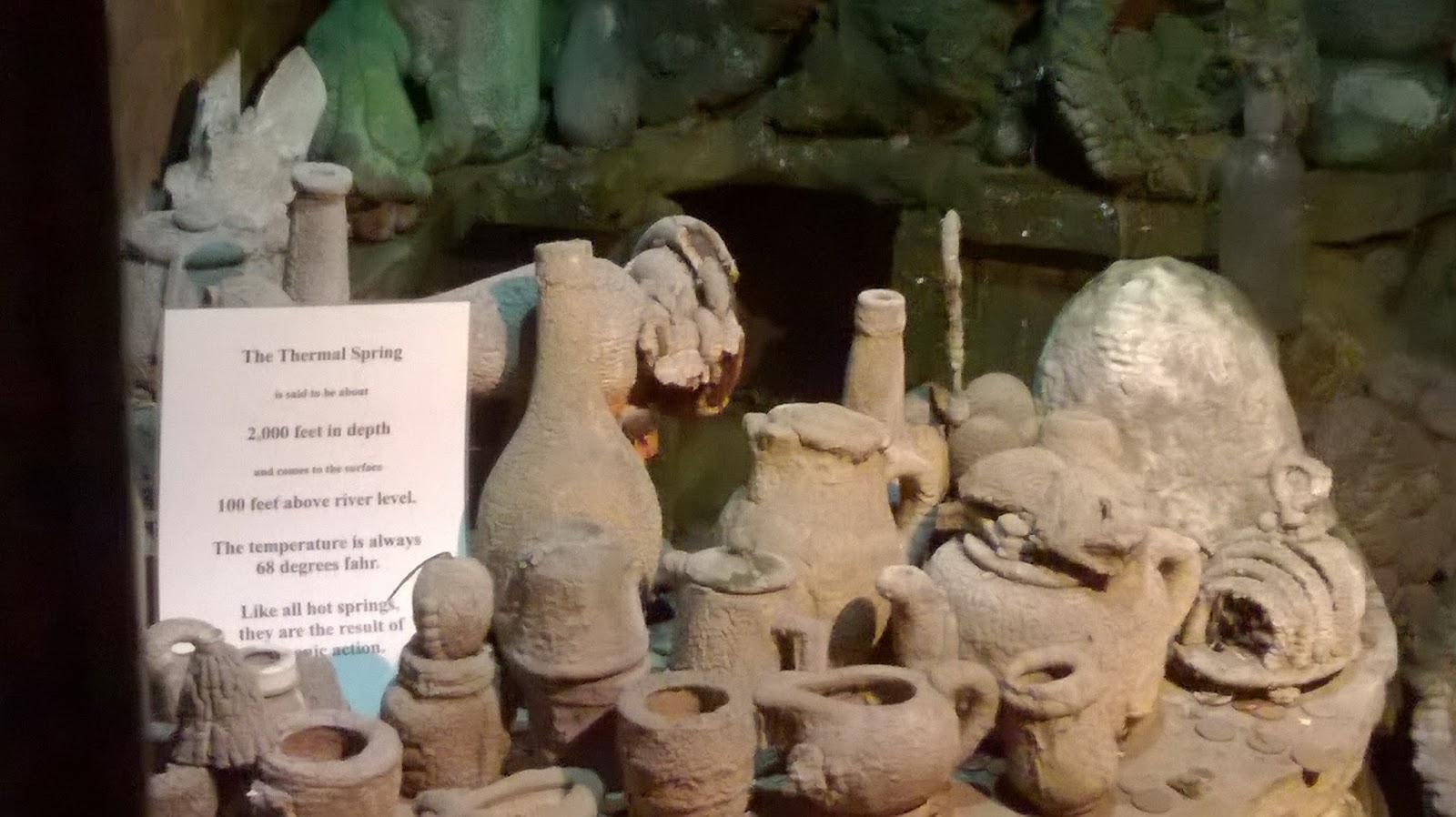
The process is simple but impressive; the water from the thermal spring is rich in a variety of minerals, in particular calcium from the local limestone. As the water evaporates, a deposit of calcium carbonate slowly builds up; over time, this turns the objects within the water to stone. 

People have visited Matlock Bath to watch this wonder for centuries, and visitors today can still see the well in action, along with a selection of items that have been petrified over the years.  

Objects petrified by the well at Matlock Bath


It is the only remaining working well in Matlock Bath. Victorian Matlock Bath boasted several "dripping wells" and items such as wigs, birds nests and brooms were petrified and sold to visitors! 


The 1868 publication "On Foot Through the Peak" describes the petrifying industry at Matlock Bath:

"Petrification working, as it is called, has become an important, and certainly not the least lucrative branch of the "curiosity" business at Matlock, there being several wells in the tufa, [I.e a porous rock composed of calcium carbonate and formed by precipitation from water] where this curious and interesting operation of nature is carried on. The process of incrustation is an exceedingly simple one, the articles to be operated on (embracing almost every conceivable object, but chiefly birds' nests, baskets of fruit, moss, and the leaves and branches of trees) are placed on stands, and the water that filtrates through the tufa allowed to drip gently upon them; the moisture in percolating through the concrete mass becomes strongly impregnated with lime, and on reaching the open air, rapidly evaporates when a calcareous deposit is formed that in time completely encrusts the object on which it falls, and gives to it the appearance and hardness of stone."


The pipe through which the water passes to the well. 

The eight year old Elizabeth Barrett was inspired by a visit to Matlock Bath in 1814 to write a poem, with the following reference to the well:

We quit this shadowy cave with vapours hung,
And joy to see the beauteous glowing day,
The rocks, woods, waters, all in bright array,
Then running, tumbling down the hill,
New wonders rise, our thoughts to fill,
Papa so ever kind, our joys to swell,
Led us to see the petrifying well,

Where heads, wigs, baskets, eggs, lie on the ground
Soon turned to stone, in dropping waters drowned.
Farewell, farewell, ye scenes of joy so sweet,
All other joys lie humbly at thy feet.

Matlock Bath has drawn visitors for centuries, and shows no sign of ceasing to be popular. One of the things I am always asked to take a photo of when we visit is the not petrified, but equally fascinating collection of dinosaur eggs.  


Then there is the giant amethyst, the ammonites, and to mention the impressive collection of Minor,  Common and Koi Carp enjoying the waters of the old therapeutic baths that the town is named for. In short, if you happen to be in the Derbyshire area, Matlock Bath is well worth a visit!


Because you can't end a day at Matlock Bath without chips.