Showing posts with label Reviews. Show all posts

Sunday, 13 August 2017

The Yorkshire Witch: A Tantalising Read


Superstition. Cunning. Manipulation. Murder.

On 20 March 1809, Mary Bateman was executed in York for the murder of Rebecca, wife to William Perigo. Although the last, this was likely not the first murder to Mary's name, 'The Yorkshire Witch' leaving a trail of theft, poisoning and deceit behind her as she took her place at the gallows. 

The tale of Mary Bateman is so sensational that a reader would be forgiven for thinking the details to be a work of crime fiction rather than real life. Despite, or perhaps because of this fact, there has not been a full look at Mary's life and acts since the pamphlet written not long after her execution. Summer Strevens however redresses the balance in The Yorkshire Witch: The Life and Trial of Mary Bateman, giving the fascinating and gruesome events their first full airing for two centuries.

It has been well worth the wait: Strevens has clearly done her research, including in her study of Mary's life such varied and tantalising details as the geographical layout of 19th century Leeds and the history of the storage of poisons, that help to bring the time and context into sharper focus and add a further fascinating layer to the incredible story. She also makes good use of the often underused resource of parish records, adding biographical details to further enhance the fragmentary glimpses into Mary's story. 

Written by a skilled and accurate narrator, The Yorkshire Witch is a compelling blend of historical research and storytelling. Along with giving the known details of Mary's life and the harrowing relation of her murderous schemes, Strevens ventures some interesting speculation regarding Mary's mental and psychological state. Ultimately however she accepts that we just don't know why Mary carried out the acts she did, leaving the case ultimately open. 

The Yorkshire Witch is available from Amazon and Pen and Sword Books.  


Monday, 18 January 2016

The Women of Walkern: Which Could be a Witch?


The trial of Jane Wenham for witchcraft in 1712 was one of the last in England before the passing of the 1736 Witchcraft Act meant witchcraft was no longer a crime punishable by law. As anyone following here at The Witch, The Weird, and The Wonderful will know by now, Jane and her story have fascinated me since I started writing about the goings on in Walkern for Accused. It was hardly surprising that I got incredibly excited to learn of the play Jane Wenham: The Witch of Walkern. Written by Rebecca Lenkiewicz, produced by Out of Joint and directed by Ria Parry, this superb piece of theatre not only gives the essential elements of Jane's case an accessible and thought-provoking spin, but acts as a mirror to the culture and community of the times of the witch trials in general.


The play stands out immediately for having a predominately female cast, a rare enough thing even in this day and age. This isn't just done for effect: each character is fully-drawn in awe-inspiring detail, and the play without question passes the bechdel test. There is more than that however – it isn't by accident that those five characters represent five separate sub-categories of women – those most likely to be particularly vulnerable during the time of the witch trials and beyond, those most likely to be both accusers and accused. For when tragedy strikes the already unstable community of Walkern, the hunt is on to find someone to blame - someone guilty of both murder and witchcraft. 


Jane Wenham and Ann Thorn

The Cunning Woman:
Common in local communities even into the 20th century, the cunning woman performed several roles: performing love magic, locating lost property, providing charms to protect people and animals, and aiding with any number of ailments. They also dealt in counter magic, offering cures for those who thought themselves bewitched. 

In the play, Jane Wenham is portrayed as Walkern's cunning woman: collecting herbs to make her salves and possets, snuggling with her chicken James for warmth at night, Jane is seen as “odd” by her neighbours, but generally tolerated. In the heightened atmosphere of tension after Elinor Thorn's hanging for witchcraft however tongues start to wag, and Jane's eccentric behaviour is seen as something more sinister by the newly arrived Reverend Crane, who sets out to discover her "guilt".

The cunning woman had a somewhat ambiguous role in the community she served. For while she was often seen as a protective and curative force, in times of strain or unrest, or if she failed to help someone who came to her, she could just as quickly come under suspicion herself. It was therefore not unusual for the cunning woman to become a target for accusations, the line between black magic and the protective magic she dealt in becoming increasingly blurred. William Perkins condemned all "magic" equally, stating that "by Witches we understand not those only which kill and torment: but all Diviners, Charmers, Juglers, all Wizards, commonly called wisemen and wisewomen." 

 The historical Wenham may or may not have fulfilled the role of cunning woman role in the Walkern community, but it is possible that she tried to help Ann Thorn in some capacity, as the young woman is recorded as having lamented that Jane had "ruined" her. 

Historical cunning women accused of witchcraft include potentially Jane Wenham herself and Joan Peterson, the infamous Witch of Wapping. 


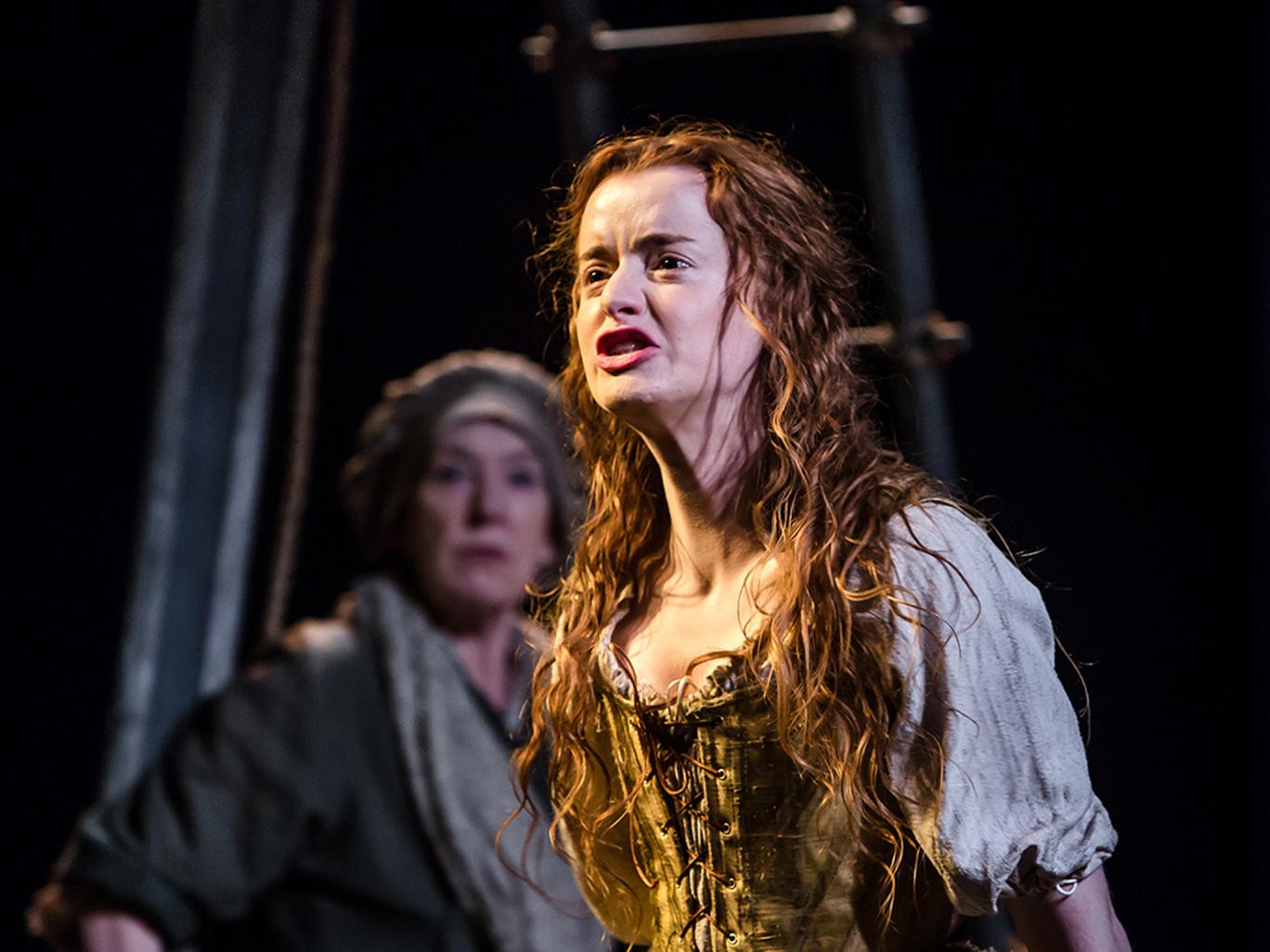
Hannah Hutch as the troubled Ann Thorne

The Young Girl: 
Girls in their teens play a prominent role in many a witch trial tale, their emotional and biological volatility leaving them, it has been suggested, particularly open to being exploited and to believing their own flights of fancy. 

The play opens on Ann Thorn reeling with shock after her mother is hanged for witchcraft: young, friendless, not knowing which way to turn, Ann is torn between the seeming support of two local women and her friend Jane Wenham.

Both the stage and historical Ann were instrumental in the accusations against Wenham. Feeling betrayed by her friend after discovering Jane has lied to her regarding her past, Ann turns on the older woman, denouncing her at the urging of the rest of the village and abandoning her to her fate. In the historical story of Jane Wenham, it is Ann Thorn who is one of the earlier to make accusations against Jane Wenham, declaring that the old woman had made her run to collect sticks and sent her into fits.

In addition, Ann of the play has the added taint of being the daughter of a witch: it was believed that witchcraft passed through families, as witnessed in the Pendle and Warboys cases among others. Her mother was also known for her immoral behaviour throughout Walkern, and her own confused behaviour more than hints at the belief in “like mother, like daughter.” 


Reverend Crane and The Widow

The Widow:
Widows were two-a-penny in 17th century England, with women tending to outlive their husbands rather than vice versa throughout the period of the witch trials. 

Although many widows found themselves destitute and beholden to the parish, Walkern's widow is the landlady of the local alehouse and financially independent. Anything of importance is discussed within her walls, and there is little that goes on that she does not know about. Her unmarried state however leaves her unexpectedly vulnerable; not only to accusations of immorality due to her affair with a married man, but also to being a temptation to men such as the virginal Reverend Crane. A woman with property and not visibly controlled or protected by a man was ultimately dangerous, leaving her open to attack. 

Widows who were accused of witchcraft include Mother Sutton of Milton Ernest and Mary Lakeland, one of England's few witches to be burned at the stake for the crime of murdering her husband through witchcraft.


Judith Coke as Priddy Goodstern

The Old Woman:
“Old” did not necessarily mean the same in Jane Wenham's time as it does to us today: then, being over fifty could mean being labelled or ancient. As with widows, there were many more "ancient" women than there were men and it was a vulnerable position to have indeed: the elderly were more likely to be in need and to ask for charity from their neighbours, leading to recriminations and guilt on both sides if requests were refused. Age and infirmity could also increase irritability and an unpleasant nature, leading to conflict with one's neighbours. 

Walkern's Priddy Goodstern is not only old but blind, and it is likely that she has often found herself in need of assistance from the community. A large proportion of women accused of witchcraft were referred to as “old”, and Priddy is indeed seen meeting with local woman Bridget Hurst and Ann Thorn and discussing when “the black man” or the Devil has visited her both as a child and in later life. 

Priddy's blindness brings to mind that of Old Demdike, one of the notorious "Pendle" witches. 


Kemi Martha and Ann Thorn

The Servant:
A run-down of the women of Walkern would not be complete without mention of the servant, a class known historically for gossiping and being too quick to believe tales of witchcraft and superstition. 

A former slave from Virginia, Kemi Martha now works as housekeeper to the Bishop. She is free to come and go as she pleases and is paid a wage, but her position only offers her a certain degree of protection: like other servants at the time, ultimately she is at the mercy of her employer's good will, a fact particularly starkly represented in Kemi's relationship with the Bishop. Already the target of gossip due to her skin colour and intimacy with her employer, as tensions begin to rise in the village Kemi finds herself under yet closer scrutiny, relating how, upon rolling a bucket down the hill, Bridget Hurst and Priddy Goodstern whispered about her. 

The character of Kemi is particularly reminiscent of Tituba, the "Indian" slave who was accused at the start of the Salem witch trials, twenty years before the events in Walkern. The bucket incident also harks of true events, as the accusation that she had made a bucket run to her down a hill was used against young Mary Spencer in 1634.


Jane Wenham: The Witch of Walkern is showing at the Arcola Theatre, London, until 30th January.  

My review of the play can be found here

* All production images copyright Out of Joint/Richard Davenport


Monday, 26 October 2015

Witch Hunts for Today: Jane Wenham: The Witch of Walkern

Back in October I had the pleasure of watching two performances of Jane Wenham: The Witch of Walkern at The West Yorkshire Playhouse in Leeds. A new play by Rebecca Lenkiewicz and Out of Joint Theatre, and directed by Ria Parry, Wenham is inspired by the momentous events that took place in 1712 in the Hertfordshire village of Walkern, when Jane Wenham was one of the last women to be condemned of witchcraft in England.


Far from being a straight telling of the historical narrative, the play takes the core concepts of the Wenham case and uses her story as a vehicle to explore the timeless themes of consent; identity; grief; loss; sexuality; and desire. By turns amusing, chilling and poignantly thought-provoking, this gripping piece of theatre transcends the historical record to present a relevant, modern, frequently uncomfortable, but entirely necessary, take on witch hunts both then and now.

For, in the close-knit community of Walkern, everyone has a secret to hide. From the Widow Higgins at the local alehouse to Samuel Crane, the newly-appointed reverend, there is no one – whether in thought or deed – who is guilt free. The need to point the finger at others in order to alleviate deep-seated feelings of shame and culpability are central to the careful policing that goes on within any community: creating a well-spring of barely suppressed disquiet that could, at any moment, bubble over into hysteria. When tragedy strikes Wenham becomes the scapegoat – the sacrifice - for the community: the enemy within that must be flushed out before safety and order can be restored. Highlighting not only how accusations of witchcraft could destroy a community from the inside but also drawing  stark parallels with today's perception of the hidden enemy within, this popular idea of blaming the other is shown as what it is: the de-humanising and persecution of those who are different and dare not to conform.

Imagery from the history of the witch trials that rocked England in the 16th and 17th centuries features heavily throughout: swimming and pricking a witch; the belief that a witch could turn into animal form; the deep-seated distrust of a woman's closeness to her pet. Ludicrous as they may seem to our modern eyes, they act not only as a reminder that such beliefs were deeply ingrained in the culture of the day and taken with deadly seriousness, but also as an invitation to examine the all-too-similar whispers and sweeping judgements that make up society today. The mounting sense of suspicion, panic and eventual hysteria are therefore as much a commentary on the 21st Century as Wenham's time.

The play also addresses two connected and pressing issues within theatre today: the dearth of plays reaching the stage by female playwrights and the lack of female protagonists. Wenham tackles both by daring to be written, directed and predominantly acted by, women. The very topic of the play – that of the witch hunts – brings issues of gender to the fore. The society in which Wenham lived, and the witch trials themselves, were, on a day-to-day level, policed by women, with women taking a prominent role as both accusers and accused. The myriad of small yet constant interactions within the daily to and fro of village life provided the fertile ground from which suspicions and accusations could, and did, spring with devastating consequences.


© Richard Davenport/Out Of Joint Theatre.

The passion of the script is matched by the carefully selected cast: Among the sterling performances David Acton's portrayal of the intellectually-energetic and troubled Francis Hutchinson was a joy to watch, contrasting neatly with the equally unsettled and tortured religious conviction of Tim Delap's Reverend Crane. Acton also makes for a marvellously obnoxious Saul Paterson; village stalwart and drunk, he also acts as a chilling reminder of the precarious position held by in society with his half-threatening "I keep you safe" to Widow Higgins. 

Amanda Bellamy makes for a deeply sympathetic, and often heart-breaking, Jane Wenham, by turns defiant and bewildered as she is isolated and tormented by her neighbours. She epitomises, as the historical Wenham does throughout the sources, many well-documented attributes common to those who were accused as a witch: unafraid to speak her mind, elderly and vulnerable due to a lack of protection from husband or family, Bellamy's Wenham retains her spirit to the last, broken but not defeated as she shouts curses on the village as she is led away.

Rachel Sanders as the grieving Bridget Hurst and no-nonsense Widow displays a wonderful versatility in her moving and accessible portrayals of both, while Judith Coke's sightless Priddy Goodstern is by turns bawdy, shocking, and a chilling reminder of lost childhood. Andrew Macklin tugs at the heartstrings as the deeply unhappy Fergal McGuire, even as his performance as the Pricker leaves you squirming in your seat.

Cat Simmons as Hutchinson's housekeeper Kemi Martha never fails to draw the eye when she is on stage. The character with the arguably lowest social status due to her position and the colour of her skin, Kemi in fact provides the unlikely thread that weaves the whole piece together: her haunting singing following through to the final scene and remaining with you long after you have left your seat. Finally, but by no means least, Hannah Hutch catches perfectly the frantic, disturbed nature of Ann Thorn. Haunted by her past and her own, unacceptable, nature, she moves through the events that unfold with a desperation that is palpable; running, jumping, always moving, building to a fever pitch that threatens to destroy everything and everyone around her. 

(And no review of Jane Wenham would be complete without a shout out to James the cockerel. Although only seen once he is often mentioned and he remains, without a doubt, a star along with the rest!)

Ultimately, Jane Wenham: The Witch of Walkern is a vital and timely piece of theatre. At the very core it holds a mirror to society today, never more apparent than when the Widow asks towards the end of the play:

"Where does all the hate hereabouts come from?"

Fergal's answer is perhaps the most revealing of all, as he tells her:

"People are unhappy. Jealous. They enjoy another's suffering."

He then adds the ultimate question, tinged with a disbelief that we should share, as we question and examine the all-too-ready willingness of people to turn against one another even in these "enlightened" times:

“Unless they truly believe it all.

Do they?”

*********


Monday, 11 May 2015

Savage Magic: A Magical Must-Read.

There are very few books that would have me up until gone midnight, huddled in the cramped bathroom of a London Travel lodge. Savage Magic by Lloyd Shepherd, however, is one of them. 

[NB I'm not weird – the other half was out gathering beer to review for his blog, the kids were asleep and you have to snatch these opportunities with both hands.


This is the first review here at The Witch, The Weird, and The Wonderful, and there is not a better book to set the standard than Shepherd's tale of madness, magic and maleficium. The year is 1814, and Charles Horton, a water constable with the Wapping River Police, is left distraught when his beloved wife, Abigail, leaves him to voluntarily become a patient at Brook House, home for the deranged. His worries are only just beginning however, when he is contacted by top London magistrate, Aaron Graham. There are strange things going on at Thorpe Lee House in the Surrey village of Thorpe, and Horton is charged with getting to the bottom of these mysterious circumstances. 

Elizabeth Hook, the cook at Thorpe Lee House, has been dismissed, suspected of using witchcraft to harm the household, including Graham's estranged wife and daughter. Is she to blame, or are there more sinister forces at work? As Horton throws himself into dealing with the less than welcoming inhabitants, at Brook House, Abigail finds herself drawn to a mysterious and disturbed young woman, Maria, who appears to be in possession of strange abilities. The urgency increases when a series of gruesome and unexplained deaths leave Aaron Graham baffled and in a race against time as, all the while, a dark presence can be felt closing in on all concerned. What binds together the aristocratic members of a club called the Sybarites, the women in Brook House and the household at Thorpe Lee House? And, more importantly, will Charles Horton manage to figure things out in time?

 Brook House was a real house for the deranged, pictured here in 1800.


It was during a late-night browse that I came across Shepherd's page and instantly fell in love. With a book cover. My husband can vouch for that – he very indulgently looked as I waved the laptop in front of him and declared that  the cover of Savage Magic was the most beautiful cover I had ever seen in my life. Add the fact that the book promised magic, mystery and witchcraft and I was guaranteed to buy it. I don't tend to buy on impulse, but on this occasion, I was most definitely not disappointed. 

One thing that particularly leaps out about Shepherd's style is that it is so easy to read. Crisp, clean sentences conjure up the characters and their world effortlessly, and the only complaint I have is that once I picked the book up, it was incredibly hard to put it down! The colourful cast of characters is best left for the reader to discover, but this review wouldn't be complete without giving one a particular mention. Abigail Horton is one of those all-too-are female characters that are interesting in their own right. Her personality can be felt from the first moment we see her, her strength of character coming through loud and clear. She's intelligent, confident and witty without the fact being rammed down the reader's throat, and, most of all, she comes across as being real

Savage Magic is a well-written, vibrantly populated page-turner, but now to the nitty-gritty: does the magic element pass muster? I'm the first to admit to being picky when it comes to fiction dealing with a subject area close to my heart, and nothing could be closer than tales of magic and witchcraft. Savage Magic escapes the pitfalls that so many other novels fall into, however, and it is clear that Shepherd has done his research. There was no point where the story jars or throws the reader out, the careful blending of fact and fiction seamless, entertaining, and highly satisfying. 


River Police Headquarters at Wapping, 1891

If it wasn't already obvious, I would highly recommend Savage Magic, and it is on my re-read list – after Shepherd's first two novels, The English Monster and The Poisoned Island of course.  Check out Lloyd Shepherd on Twitter at @lloydshep, and at his Amazon Author Page.

Update: The Fourth and final book in the Horton series, The Devil and the Detective, is due out on April 21st, and can be pre-ordered here. It promises to be as fantastic as the rest of the series, so go and order your copy now! 

Lloyd Shepherd is also currently working on the exciting Riddle of the Sands project. Check it out, and if it captures your interest, you can pledge support in exchange for some exciting rewards and a dose of adventure here