Monday, 13 July 2015

Where's a Witch to Rest? Chimney Stacks and Witches' Seats.

There is a curious sight that can still be seen today in the Channel Islands: the legendary  witches' seat or stone.  


In evidence in both Jersey and Guernsey, these small plinths or ledges were, it was said, built for a very important purpose. Witches, travelling across the island on their brooms, were often in need of a place to stop and catch their breath, and more than capable of punishing a householder if they did not provide a place for him or her to rest. Worse, if there was no ledge or “seat”, then the witch might come into the house itself to seek refuge, and if you were really unlucky, might choose never to leave!

Witches' Seat on a traditional thatched roof


Witches would meet on a Friday night at various locations across the islands, with dancing and revelling lasting well into the night. The witches might, understandably, grown tired on the way home, and thus the “seats” were necessary to keep the tired witches from seeking revenge on those who did not think of their comfort. There is also a variation on this theme in the fireplace “corbels”. These stones stuck out through the wall and provided a ledge outside the building, and thus another useful place for a witch to stop. 

Grande Greve, Sark 
Known as a popular meeting place for witches. 


The real purpose of these ledges was somewhat less fantastical. Rain water running down each side of the chimney would, over time, do damage to the thatch, and so the "seats" served the purpose of providing the necessary protection against this eventuality. It is unclear which came first; the belief in the witches' resting place (for which the ledges were them appropriated), or whether the architectural design led to the creation of the legend. 

In the 18th century, tile was introduced to replace the earlier thatch, which in turn were replaced by slates as the material of choice as time went on. Interestingly, as these new roofs were thinner than the older thatched ones, the stone ledges stuck out much more noticeably in the new designs. 

"Seat" on a lead roof. 


A newspaper of 1971 showed the belief was still going strong:

“Those stone blocks sticking out of the walls of some of the old houses in Guernsey are not evidence of faulty workmanship – they're witches seats. The old folk on this British Channel Island off the coast of France knew that witches got tired on their flights around the island, and needed somewhere to rest.”

Witches making good use of the seats!


So ingrained is the belief in fact, that even today, some newly built houses have witches' stones built into their design as a matter of course, despite never having been thatched!

"Seat" on a modern roof. 


Thursday, 9 July 2015

Daily Bread: The Curse of Two Jersey Witches

Bread lies at the centre of many a story; little surprising given its importance throughout history as a staple of the average diet. Bread has been baked, shared, fought over, ruined, refused, exchanged and blessed throughout history and fable alike, and two tales of bread and witchcraft are to be found in the rich folklore of Jersey, the largest of the Channel Islands. 


The first tale begins with a young girl named Nicolette. She quarrelled with an old woman, a foolish thing to do, as the woman in question was well known to be a witch. What the argument was about is not revealed, but the angered witch got the last word, declaring that:

“Neither mouthful nor morsel of bread will henceforth pass thy lips.” 

When Nicolette returned home, she indeed found the witch's pronouncement to be true, and she was unable to force even the smallest crumb past her lips.

In despair, Nicolette visited a local "white" witch to ask for guidance, where she was instructed to:

“Go to town and buy a packet of new pins and a new saucepan. When you return home, scrape and scour the pins so that they may be bright and clean, and at midnight, when your household is asleep, steal softly down to the kitchen and boil them in the new saucepan.”

This would, the white witch informed her, result in the witch who had cursed her appearing at the door, begging for Nicolette to cease tormenting her. When this happened, Nicolette would then in turn be able to ask for the curse to be lifted. 

The young woman duly followed this advice. Sure enough, as midnight passed, the windows rattled and there was loud banging at the door, quite terrifying at that time of night.

“Stop tormenting me!” the witch cried from outside.

The girl's response left no doubt as to the purpose of her actions, as she cried back, “Let me eat bread, then!”

“Eat it, eat it!” The witch capitulated. The spell was thus broken, and the triumphant Nicolette able to eat as she had before.  


There is another similar tale involving a fourteen year old boy named Edward. He too had been reckless, and had not listened to tales regarding the "Black Lady". 

This was to be at great cost, as he discovered one day when he followed after her, taunting her and calling her names. His glee turned to terror as she turned to glare at him, gaunt and death-like in appearance, her haunting eyes fixing him to the spot.  

“it will be a fine day, my boy," she declared,  "before you eat bread.”

With those words she carried on, but with that, Edward's life was changed forever.

That night as he sat with his family to eat, his perplexed parents asked why he did not touch the fresh bread that he so usually enjoyed. He related the tale of his encounter with the “Black Lady”, and they listened with no little horror, knowing only too well what the woman was reputed to be capable of. 

Their fear was, it seemed, justified; every time Edward put the bread to his lips he could not make it pass into his mouth. He tried everything possible, but still could not bring himself to eat it despite his distress.  

Years went on and still the situation did not change. Once healthy, Edward was now visibly wasting away, weak, unhappy, and still unable to eat bread. To make matters worse, the mysterious lady who had cursed him had moved from the area shortly after afflicting Edward, and was nowhere to be found.

At the age of eighteen, the future did not look good for the sickly young man. The doctor had gravely told the family that, unless he could be induced to eat, Edward would not survive for much longer. There was, he said, nothing that could be done.

Fate, however, intervened. On the fourth anniversary of Edward's unlucky encounter, he awoke at three in the morning, dashing to the kitchen with all the strength his wasted body afforded him. Once there, he grabbed a loaf of bread, cramming chunks into his mouth as if – and it very nearly did – his life depended on it. His father discovered him at dawn, still eating with enthusiasm, the curse, at last, lifted from him.  

What had caused his sudden deliverance? The answer came when Edward's father visited the doctor the following day to tell him the miracle of his son's recovery. The doctor, it turned out, had the answer to this riddle. The Black Lady had died, and the spell breaking with her, at three am the very morning Edward had started to eat.  


Monday, 6 July 2015

A "Petrifying" Visit to Matlock Bath

Since moving to Derbyshire, Matlock Bath has become one of our favourite places to visit. It's like the seaside but without the sea, (although there is the river, and a lovely big sandpit at the “ship park” where the kids can while away many a happy hour,) and with ice cream in the secret garden, the delightful "alternative" clothing shop, and plenty of lovely walks, it's a full and fabulous day out.   


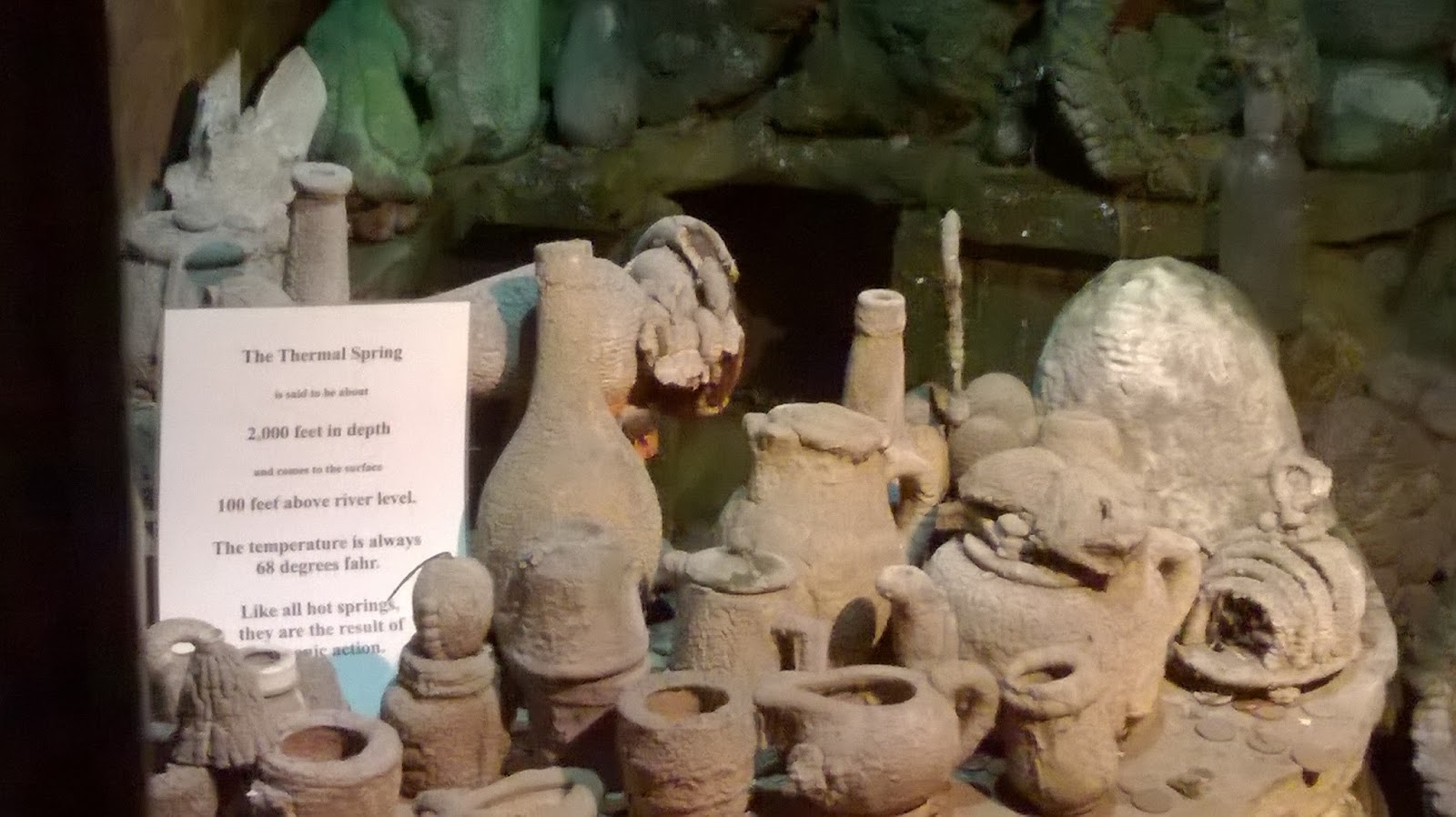
One of our very favourite haunts there however, is the aquarium. The kids love the big fish, I love the collection of gem stones, and we all spend a good long while admiring the wonders of the petrifying well.  


The process is simple but impressive; the water from the thermal spring is rich in a variety of minerals, in particular calcium from the local limestone. As the water evaporates, a deposit of calcium carbonate slowly builds up; over time, this turns the objects within the water to stone. 

People have visited Matlock Bath to watch this wonder for centuries, and visitors today can still see the well in action, along with a selection of items that have been petrified over the years.  

Objects petrified by the well at Matlock Bath


It is the only remaining working well in Matlock Bath. Victorian Matlock Bath boasted several "dripping wells" and items such as wigs, birds nests and brooms were petrified and sold to visitors! 


The 1868 publication "On Foot Through the Peak" describes the petrifying industry at Matlock Bath:

"Petrification working, as it is called, has become an important, and certainly not the least lucrative branch of the "curiosity" business at Matlock, there being several wells in the tufa, [I.e a porous rock composed of calcium carbonate and formed by precipitation from water] where this curious and interesting operation of nature is carried on. The process of incrustation is an exceedingly simple one, the articles to be operated on (embracing almost every conceivable object, but chiefly birds' nests, baskets of fruit, moss, and the leaves and branches of trees) are placed on stands, and the water that filtrates through the tufa allowed to drip gently upon them; the moisture in percolating through the concrete mass becomes strongly impregnated with lime, and on reaching the open air, rapidly evaporates when a calcareous deposit is formed that in time completely encrusts the object on which it falls, and gives to it the appearance and hardness of stone."


The pipe through which the water passes to the well. 

The eight year old Elizabeth Barrett was inspired by a visit to Matlock Bath in 1814 to write a poem, with the following reference to the well:

We quit this shadowy cave with vapours hung,
And joy to see the beauteous glowing day,
The rocks, woods, waters, all in bright array,
Then running, tumbling down the hill,
New wonders rise, our thoughts to fill,
Papa so ever kind, our joys to swell,
Led us to see the petrifying well,

Where heads, wigs, baskets, eggs, lie on the ground
Soon turned to stone, in dropping waters drowned.
Farewell, farewell, ye scenes of joy so sweet,
All other joys lie humbly at thy feet.

Matlock Bath has drawn visitors for centuries, and shows no sign of ceasing to be popular. One of the things I am always asked to take a photo of when we visit is the not petrified, but equally fascinating collection of dinosaur eggs.  


Then there is the giant amethyst, the ammonites, and to mention the impressive collection of Minor,  Common and Koi Carp enjoying the waters of the old therapeutic baths that the town is named for. In short, if you happen to be in the Derbyshire area, Matlock Bath is well worth a visit!


Because you can't end a day at Matlock Bath without chips.  


Thursday, 2 July 2015

Creepy Caves: The Mystery of Mortimer's Tunnel

Situated on Castle Rock, Nottingham Castle rests an impressive one hundred and thirty feet above the city. Although very little of the original castle exists today, the series of caves and tunnels that run through the cliffs continue to draw visitors and investigation, with over four hundred known caves currently documented and catalogued. 


One of these, known as Mortimer's Hole or Tunnel, has a particularly fascinating legend attached to it. The story is related in Links with Old Nottingham: Historical Notes by J Holland Walker, in 1928:

"In 1330, Roger Mortimer and Queen Isabella took refuge in Nottingham Castle, where they lived together flaunting all decorum and allocating to themselves regal powers to which they had no right.

Such a state of affairs could not be permitted to continue, and so the young King Edward III. headed a band of his faithful nobles and by means of a secret passage to the Castle succeeded in surprising the usurping pair, arresting Mortimer and leading him off to execution and dispatching Queen Isabella to an open and honourable imprisonment at Castle Rising in Norfolk."


The tunnel, over one hundred metres long, stretches from Brewhouse Yard up into the castle grounds. It is not possible to travel the full length along it, but it is clear that there were once six gates, with steps cut into the rock. There is also evidence of use by cannon in the Civil War. It would have provided a useful method of communication from the Castle down into what was then called the Rock Yard, and also for getting supplies to the castle from the River Leen. 

As to be expected with such a history, there are many intriguing tales about Mortimer's Hole. One of the most prevalent is that the ghost of Roger Mortimer himself haunts the tunnel. In 1921, tales of a ghostly presence in the area around Standard Hill so terrified inhabitants there that they would not venture from their houses after nightfall. One man, however, decided to see what was going on; setting himself on watch in the tunnel he waited, until he was finally rewarded with the sound of footsteps coming up from the basement, accompanied by the noise of rustling paper. There was no confrontation, however, as when he called out to the presence, the footsteps retreated once more. This account led to a great influx of tourists, each determined to see the ghost for themselves, and there are many who believe that the ghost of Mortimer remains there to this day. 

Showing the tunnel from the Castle down to Brewhouse Yard
Trent & Peak Archaeology/University of Nottingham

There is also a tradition that a room where Isabella and Mortimer met for their assignations can be found at the back of the pub, Ye Olde Trip to Jerusalem which claims, along with many others, to be the oldest in England. Among other ghostly experiences, in the 1940s, it is said that a group of American soldiers were walking past the Inn when they were startled to hear a woman screaming in a foreign language. It has been suggested that it might have been the ghost of the French Isabella, shrieking for mercy for her doomed lover. 

It had long been suggested that this was not the actual tunnel used by Edward III at all, and that the tunnel named Mortimer's Hole was actually a service tunnel or such leading up from the River. There has been speculation over various possibilities, but in 2010 the "real" Mortimer's Tunnel was discovered to have been what is known as the North-Western Passage. This runs from the house of Castle Grove in the Park Estate (private property) and stretches 30-40 metres. The two year long Caves Survey used laser scanning to record 3D records of Nottingham's sandstone caves.  

The "Real" Mortimer's Hole, looking up towards the castle. 

Cave Tours run from Nottingham Castle on a regular basis, and with the Castle also housing the city Museum and Art Gallery, it is well worth a visit, ghosts or no!

Thursday, 25 June 2015

A Lowland Witch: The Legend of Gyre Carline

Gyre Carline – a Scots term, from the Norse for Old Woman – was a force to be reckoned with. In some accounts a giantess, others a witch or hag, she inspired terror in the hearts of those who heard tales of her exploits, and perhaps with good reason.   

One such story involves the smiting of Lochar Moss. During a gathering of fellow witches, several of Gyre Carline's horses were swept away by a high tide as they went for a ride during a gathering on Locharbrigg Hill. The area below, Lochar Moss, was then open sea, but, after a wave of Gyre Carline's staff, it turned at once into a vast, boggy mass.   

Lochar Moss


Locharbrigg Hill, about four miles from Dumfries, Scotland, had a long association with witches. It was especially known for the meetings held there on Walpurgis Night, 30th April, where witches and warlocks gathered for dancing and revels. On these occasions, Gyre Carline was second in importance only to Satan himself, presiding over the initiation of new members and the following elaborate celebrations.  

Parallels can be drawn between Gyre Carline's rides with her followers and the Hallowmass Ride or Wild Hunt. Faeries, witches or the dead were said to ride through the sky, the accompanying wind often drawing up those who got in its path. 

A rhyme supposedly sung by the followers of Gyre Carline during their rides is translated as follows:

“When the grey owl has three times hooted,
When the grinning cat has three times mewed,
When the fox has yowled three times in the wood,
At the red moon cowering behind the cloud;

When the stars have crept deep in the mist,
Lest spells had picked them out of the air,
Up horses all, without more ado,
Ride, ride, for Locherbrigg hill!


The Wild Hunt - by Peter Nicolai Arbo


There are many references to Gyre Carline. According to Sir Walter Scot, the Gyre Carline was identified also with the Fairy Queen or Mother Witch:

“A gigantic and malignant female, the Hecate of this mythology, who rode on the storm and marshalled the rambling host of wanderers under her grim banner. This hag (in all respects the reverse of the Mab or Titania of the Celtic creed) was called Nicneven in that later system which blended the faith of the Celts and of the Goths on this subject."

In Remains of Nithsdale and Galloway Song, R. Cromek describes Gyre Carline thus:

“... reckoned the mother of glamour, and near a-kin to Satan himself. She is believed to preside over the 'Hallowmass Rades;' and mothers frequently frighten their children by threatening to give them to M'Neven, or the Gyre Carline. She is described as wearing a long grey mantle, and carrying a wand, which, like the miraculous rod of Moses, could convert water into rocks, and sea into solid land.


Between two and three miles wide, the area of land that Gyre Carline supposedly struck is still known as Lochar Moss today. For centuries it fulfilled the role of a natural moat, serving as protection for Dumfries. The peat there was also cut and dried and used to provide fuel. There were plans to drain the area as early as 1754, when the engineer John Smeaton's suggestions were drawn up but not carried out, and it was finally drained in the 19th century. The transformation of the land by Gyre Carline may also have at least a little basis in fact: archaeological finds, including the remains of boats, were discovered during the draining, suggesting that the area had once indeed been open water. 


Monday, 22 June 2015

Richard Deacon and the Tendring Witchcraft Revelations

“Don't believe everything you read,” is sound advice for the historian or casual reader alike. It was particularly appropriate when, during my recent research into Mary Lakeland, burnt at Ipswich in 1645 for the crime of murdering her husband through witchcraft, I came across a book that seemed to offer some intriguing answers to the question of why she went to the flames. 


Matthew Hopkins: Witchfinder General, by Richard Deacon was published in 1976, purporting to be the first proper biography of this elusive figure. After finding it for a steal on Amazon Marketplace, I eagerly awaited its arrival, marvelling as, by chance, it opened at the exact page I needed.  

As I read, I was made aware for the first time of a document known as The Tendring Witchcraft Revelations. According to Deacon, this was an unpublished manuscript, dated 1725 and authored by C. S. Perryman. It consisted of information that had been “compiled by divers informers” between 1645 and 1650, and covered a wealth of information about Hopkins and the witch hunts of Essex and Suffolk.  Throughout the book, much of which is based on the information contained in these “Revelations”, Deacon spins a tale of intrigue and espionage, magic and mystery. Hopkins is portrayed as a sinister, shadowy figure, swapping political secrets in exchange for the assistance of astrologer William Lilly and John Thurloe, a vital link to the government in London, in his witch hunt.  

Most intriguing in view of my research however, Deacon states that based on the “firm evidence” from this source, it is possible to say with certainty that Hopkins visited Ipswich in connection with Mary Lakeland's case.  


There are numerous suggestions for why Mary Lakeland was executed whilst several others accused of witchcraft at the same time were not, but the one put forward by Deacon is perhaps the most sensationalist, and according to The Tendring Revelations:

“Hopkins, who had travelled into Hollande purposefully to be instructed in astrology... went to Ipswiche especially to examine this suspected Informer of the Royalist Lady Whorwood.”

A known Royalist supporter who smuggled both gold and information to the beleaguered Charles I, Lady Jane Whorwood was wife of Brome Whorwood of Holton Park, Oxford. She was devoted to helping the King, taking part in two, unsuccessful, escape attempts, and it is believed that she was also his mistress for a time. In a stroke of Deacon's pen, Mary Lakeland passes from poor, Ipswich widow to dangerous Royalist informer, silenced for her crimes against the state.  

 The plot thickened, as it turned out that Hopkins himself had a deeper connection with the renowned Royalist, having several meetings with the woman in which he fabricated stories regarding his history in order to conceal his Puritan leanings and win her trust. Quite what Hopkins could want with Lady Whorwood is hard to determine, but Deacon speculate that she was in fact paying Hopkins for information, and that it was this role as a double-agent that ultimately led to Hopkins' own downfall. 

Often mis-identified as Lady Jane Whorwood; 
it is in fact a portrait of her sister. 


Hopkins was, according to Deacon, finally swum as a witch himself, the Tendring Witchcraft Revelations asserting that:

“He was soe treated by his owne methodes of establishing Witches in parte by objections to his methodes by a few of his neighbours but farrre more soe by reason of the facte that he was discovered to be in league with the Lady Whorewood, an error of judgemente which seems strangelie out of character.” 

This leads rapidly to the conclusion Deacon has evidently been building to; allowing that the Tendring Revelations accept that there is a record of burial for Hopkins in the Mistley parish church, the document goes on to say that:

"nobodie in the localitie was present at hys burial and if buried he was at Mistley it may have beene outside the precinctes of the Churche in the dark of night when noone else was about his business."

His final suggestion based on this evidence is that Hopkins left the country in 1647 and fled to America, where he continued his witchfinding enterprises until the end of his days. tThe burial record, he posits, was faked by Hopkins' own mother, an easy thing to do if she was, as Deacon suggests, the second wife of Thomas Witham, the parson at Mistley at the time. 


Intriguing, thought provoking, and a definite page turner, unfortunately things are not as they seem. Richard Deacon was the pen name of Donald McCormick, journalist, historian, and former naval intelligence officer.  With a penchant for writing about sensational topics such as Jack the Ripper, Hellfire Clubs and The Cambridge Apostles, McCormick specialised in "revealing" previously unknown "facts" to a fascinated readership. Utilising to the full the maxim that a lie is most convincingly hidden between two truths, McCormick slotted his inventions almost seamlessly into historical lore, a series of what can only be seen as hoaxes.

So what of the Tendring Witchcraft Revelations and the theories Deacon/McCormick created around the supposed contents of the document? While still referenced by the unwary writer today, it is generally accepted that the "document" was in fact a product of the author's imagination. It has never been seen, and it is safe to say that it never existed outside of the fabricated quotes scattered through his book on Hopkins. 

There is also  no evidence outside of this that Mary Lakeland had anything to do with either Matthew Hopkins or Lady Jane Whorwood. 


Donald McCormick, 1959

McCormick never publicly admitted to the various hoaxes he perpetuated during his writing career, and died in 1998 at the age of eighty-seven. There are, however, clues if you choose to look; in Matthew Hopkins: Witchfinder General he makes the ironic observation that:

“Not only are many records missing, but some of them have been tampered with, others are false, and some blatant forgeries.” 


Wednesday, 17 June 2015

Haunting Hounds: The Black Dog of Bouley

Bouley Bay, a picturesque harbour on the north coast of Jersey, is well-reputed for being the perfect place for a day-time stroll. As night draws in, however, if local legend is to be believed, you would do best to be as far away as possible...

  
A ghostly hound is said to haunt the area: large and black, with huge saucer-shaped eyes, in some versions of the tale, he has the addition of terror-inducing long, sharp teeth. There have been many reports of the Dog of Bouley, or Le Tchan du Bouole as it is locally known, throughout the centuries, and he is often said to be a warning of an approaching storm. Dragging his chain behind him, he prowls through the bay at night, the noise so terrifying that those hearing it are frozen where they stand. Closing in on his prey, the spectre then proceeds to run round his victim, increasing in speed as he goes. What happened next is unrecorded, but the petrified person is discovered huddled on the ground, frozen and speechless with shock.  

Although there is no record of the dog doing any harm to its victims, it is safe to say that it is not an experience someone would want to repeat!   


Bouley Bay has a long history, and a port has been in evidence there since at least 1274. One explanation for the legend of the dog is that it was invented by smugglers using the bay, in an attempt to keep curious locals from inadvertently stumbling across their business. 

Another more improbable yet fascinating theory regarding the dog's origin was put forward by the Jersery folklorist, John L'Amy. L'Amy suggested a connection between the Tchan and the French emigres that came to Jersey to escape the Revolution. They were apparently well known for playing tricks, and he posits that one might have dressed up as a dog in order to scare the locals; with “Tchan” being a corruption of “Chouan” as the emigres were known, so a legend was born.  


Whatever the origin of the tale, today, visitors can enjoy a walk around the bay, followed by a meal at the Black Dog Pub. Don't tarry too late however, as it is still said that a sighting of the Dog of Bouley will come before a storm...